Epinephrine in OHCA —
a drug that saves the heart, or the brain?
PARAMEDIC-2 shook decades of routine epinephrine administration. What we know about timing, rhythm, and neurological outcome — and what applies to a Slovak RZP/RLP paramedic
Epinephrine has been given in OHCA for more than 50 years. PARAMEDIC-2 (NEJM 2018) was the first large randomized trial to ask the question no one wanted to ask: does it actually help — and what?
PICO — quick overview
[P] Population: Adult patients with OHCA of any etiology in whom advanced CPR was initiated
[I] Intervention: Epinephrine 1 mg IV every 3–5 minutes per standard ALS protocol
[C] Comparison: Placebo (0.9% saline) — double-blind control, identical syringes
[O] Outcome: 30-day survival (primary), neurological outcome (mRS), survival at 6 and 12 months
What PARAMEDIC-2 found — the bare numbers
The PARAMEDIC-2 trial (NEJM 2018) — 8,007 patients, 5 NHS ambulance services in England and Wales, 3 years of data collection. The result was unambiguous — and at the same time deeply concerning.
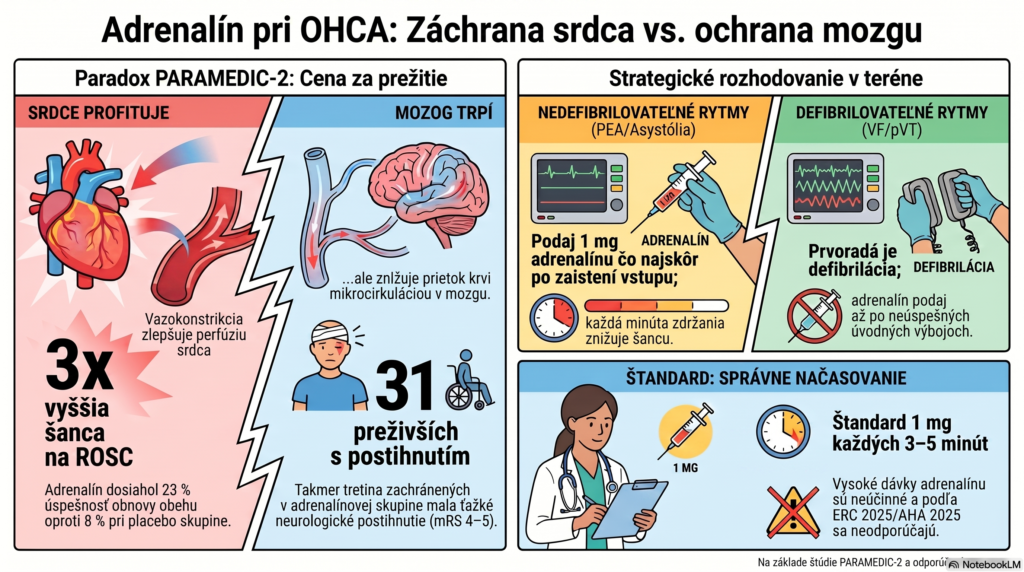
23% ROSC with epinephrine vs. 8% with placebo — a threefold difference | 3.2% 30-day survival with epinephrine vs. 2.4% with placebo — a small difference | 31% Of survivors in the epinephrine group had severe neurological disability (mRS 4–5) | 22 min Average time from arrest to the first dose of epinephrine in the trial | 2.0% Favorable neurological outcome (mRS 0–3) with epinephrine vs. 1.5% placebo — not statistically significant |
Epinephrine saves the heart, but can harm the brain. The mechanism is well understood: epinephrine improves coronary perfusion pressure during CPR, but its vasoconstrictive effect on cerebral microcirculation reduces cerebral blood flow. The result is more patients with ROSC — but more of them wake up with severe neurological damage.
At 6-month follow-up: 2.0% vs. 1.5% favorable neurological outcome (OR 1.35; 95% CI 0.93–1.97) — the difference is still not statistically significant. 12-month survival: 2.7% vs. 2.0% — statistically significant, but borderline. Cognitive and functional scores among survivors were reduced in both groups without a significant difference.
When to give epinephrine — rhythm and timing
The most important finding from PARAMEDIC-2 subgroup analysis and subsequent observational studies: epinephrine isn’t the same drug for every rhythm. ERC Guidelines 2025 and AHA ACLS 2025 have formalized this.
Non-shockable rhythms — PEA · Asystole → Give epinephrine as soon as possible after securing IV/IO access → A Japanese cohort study: given within 9 min, aOR for ROSC = 8.83 → ERC 2025: “give adrenaline rapidly for non-shockable rhythms” — COR 2a → Every minute of delay reduces the chance of ROSC | Shockable rhythms — VF · pVT → Epinephrine only after the initial defibrillations fail — not immediately → A Japanese study: epinephrine with a shockable rhythm slowed ROSC within 20 min (aOR 0.40–0.50) → ERC 2025: “give adrenaline after initial defibrillation attempts fail” — COR 2a → Priority remains defibrillation — not the drug |
A PARAMEDIC-2 sub-analysis (2020) showed: the later epinephrine is given with a non-shockable rhythm, the smaller the benefit for ROSC. With a shockable rhythm, conversely, the duration of the arrest, not the time to drug administration, is the main determinant of outcome. In VF/pVT the key is rapid defibrillation — epinephrine comes into play only once defibrillation has failed.
AHA ACLS 2025 explicitly states: “Do not use high-dose epinephrine routinely” (COR 3: No Benefit, LOE: B-R). The standard 1 mg every 3–5 minutes remains the only recommended regimen. Higher doses showed no benefit even in non-shockable rhythms.
Methodological strength of the evidence
[✓ Double-blind RCT] [✓ n = 8,007 — the largest trial] [✓ Long-term 12-month follow-up] [! Average time to epinephrine 22 min] [! Only the British EMS system]
— Strength of the trial: PARAMEDIC-2 is methodologically excellent — double-blinding, identical syringes, minimal attrition bias (only 7 patients excluded from the analysis).
— The timing problem: An average of 22 minutes to the first dose is significantly longer than the typical time in a well-functioning urban EMS. The results may underestimate the benefit of earlier administration.
— Primary endpoint: The trial was powered for 30-day survival, not neurologically favorable survival — this outcome was statistically underpowered.
— An ethical question: If epinephrine increases the number of survivors with severe neurological disability, does that correspond to patient preferences? A question without a simple answer.
Applicability under Slovak conditions
| Parameter | Status in Slovakia | Impact on practice |
|---|---|---|
| RZP competency — epinephrine | Slovak Act No. 579/2004 Coll. — an RZP paramedic has the competency to give epinephrine during CPR per standing orders | ✓ The PARAMEDIC-2 results are directly relevant to timing decisions |
| Time to epinephrine in Slovakia | In an urban setting (Nitra, Bratislava, Košice), the time can be significantly shorter than the trial’s 22 minutes | ! A shorter time = potentially greater benefit but also greater risk of cerebral vasoconstriction. Rhythm makes the difference. |
| Shockable vs. non-shockable | Slovak paramedics routinely distinguish rhythm — an AED/defibrillator is standard equipment | ✓ Applying ERC 2025 is immediately possible: VF/pVT — defibrillate first; PEA/asystole — epinephrine as soon as possible |
| High doses | Standard Slovak protocol: 1 mg IV every 3–5 min | ✓ A correct protocol — AHA 2025 definitively rejects high doses |
| Traumatic arrest | A PARAMEDIC-2 post-hoc analysis: only 123 traumatic arrests (1.5% of the sample) | ! The evidence for epinephrine in traumatic OHCA is extremely weak — priority: hemorrhage control and 4Hs/4Ts |
| Ethical discussion | In Slovakia, the discussion on limiting resuscitation / advance directives isn’t developed | ! The paramedic has no field tools to assess the patient’s preferences — the question “at what cost?” remains open |
PARAMEDIC-2 didn’t eliminate epinephrine — it eliminated its mindless routine administration regardless of context. In non-shockable rhythms, early epinephrine is strongly associated with ROSC. In shockable rhythms, premature administration can paradoxically slow ROSC. A dose of 1 mg every 3–5 min is the consensus of both ERC 2025 and AHA ACLS 2025. Neurological outcome depends on overall CPR quality and no-flow time far more than on epinephrine itself.
- Perkins GD, et al. A Randomized Trial of Epinephrine in Out-of-Hospital Cardiac Arrest (PARAMEDIC2). N Engl J Med. 2018;379:711–721.
- Perkins GD, et al. Long term outcomes of participants in the PARAMEDIC2 randomised trial of adrenaline in out-of-hospital cardiac arrest. Resuscitation. 2021;162:58–66.
- Perkins GD, et al. The influence of time to adrenaline administration in the Paramedic 2 randomised controlled trial. Intensive Care Med. 2020;46:426–436.
- Governing European recommendations. ERC Guidelines 2025: Adult Advanced Life Support. Resuscitation. 2025.
- AHA ACLS Guidelines 2025 — epinephrine in OHCA (COR 2a). Summary: EMCrit 2025.
- A Japanese cohort study — epinephrine and rhythm in OHCA. Effects of prehospital epinephrine during out-of-hospital cardiac arrest with initial non-shockable rhythm. PMC.
- ter Avest E, Lameijer H. PARAMEDIC-2: Big study, small result. Neth Heart J. 2019;27:416–420.
- Slovak Act No. 579/2004 Coll. on Emergency Medical Services — competencies of the basic-level paramedic (RZP) in Slovakia.
Paramedic with more than 15 years of experience in prehospital emergency care, RZP Leopoldov. Administrator and editor of zachranarjecool.eu.