POCUS and eFAST in Hemorrhagic Shock —
can a paramedic do it without a physician?
What the latest studies say about the diagnostic accuracy of paramedics performing prehospital ultrasound — and how realistic implementation is within the Slovak EMS system
Prehospital POCUS is ceasing to be the exclusive domain of physician-staffed crews. A series of studies from 2024–2026 maps the real-world results of paramedics trained in the eFAST and RUSH protocols — and the results are surprisingly consistent.
PICO — quick overview
[P] Population: Adult patients with blunt thoraco-abdominal trauma or suspected hemorrhagic shock in the prehospital setting
[I] Intervention: eFAST/POCUS performed by a paramedic (without a physician) after a structured training program
[C] Comparison: Clinical decision-making without POCUS, or the reference standard (hospital CT/sonography)
[O] Outcome: Diagnostic accuracy (sensitivity/specificity), change in clinical decision, time to definitive care
Key studies and what they found
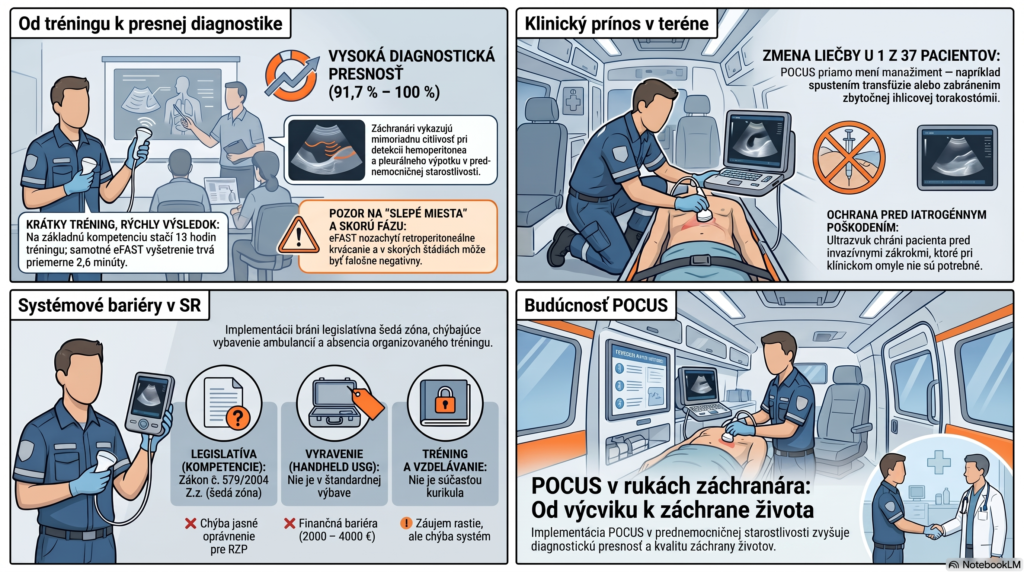
Scand J Trauma · 2026 Paramedic POCUS after structured training (Germany) 91.7% eFAST sensitivity for hemoperitoneum and pleural effusion. Specificity 100%. 21 paramedics, 169 examinations, 24-month follow-up. | Prehosp Emerg Care · 2024 HEMS retrospective series — eFAST changes clinical care 2.7% Cases where POCUS directly changed management (655 patients, 258 examined). Predominantly: preventing unnecessary thoracostomy and triggering transfusion in unclear shock. | Prehosp Emerg Care · 2025 Rural pilot program — paramedic interpretation accuracy 100% eFAST interpretation accuracy in simulated scenarios (average exam time 2.6 min). Note: controlled setting, not real-world field conditions. |
False-negative eFAST results are a real risk particularly in the early post-traumatic phase, before sufficient free fluid has accumulated. Repeat examination (serial FAST) reduces false negativity by up to 50%. Retroperitoneal hemorrhage remains a blind spot — eFAST standardly does not detect it.
Integrating inferior vena cava diameter measurement (IVC-US) into the standard eFAST protocol shows promising results for rapid recognition of hemorrhagic shock. IVC collapsibility correlates with hypovolemia. This is so far a narrative review — a large prospective RCT is lacking.
The figure of 2.7% of cases with a management change may seem modest at first glance. In the context of trauma, however, it means: for every ~37 patients examined, 1 receives different — potentially life-saving — management. Given the high prevalence of severe trauma in HEMS practice, this is a clinically relevant figure.
A paramedic’s diagnostic accuracy with POCUS
91.7% eFAST sensitivity (hemoperitoneum, pleural effusion) | 100% eFAST specificity (Scand J Trauma 2026) | 100% eFAST sensitivity (rural pilot, 2025 simulation) |
70% Specificity of abdominal ultrasound outside the eFAST protocol | 2.6 min Average time for a complete eFAST examination | 13 hrs Minimum training to reach basic competency |
Methodological strength of the evidence
[! Predominantly retrospective studies] [! Small samples (n = 21–258)] [! No large RCT for non-physician POCUS] [! Simulation ≠ real-world field] [✓ Consistent results]
— Publication bias: Programs where POCUS didn’t work are less likely to be published. The available literature may overestimate real-world accuracy in routine practice.
— Patient selection: HEMS studies include more severe cases — results can’t be transferred to ground-based basic-level (RZP) crews without correction.
— Training variability: From a 13-hour course to long-term multimodal programs. Minimum training needed for reliable field accuracy isn’t defined.
— Time pressure of the field: Laboratory conditions don’t capture noise, vibration, movement, stress, and cooperation with other crew members.
Applicability under Slovak conditions
| Parameter | Status in Slovakia | Impact on POCUS implementation |
|---|---|---|
| RZP competencies | Slovak Act No. 579/2004 Coll. — POCUS is not explicitly included in RZP competencies | ✗ A legislative gray zone — an RZP paramedic has no clear legal authorization for diagnostic ultrasound |
| RLP / physician competencies | An RLP crew physician has competency for diagnostic ultrasound | ✓ POCUS is immediately implementable on RLP — depends only on device availability and physician training |
| Ambulance equipment | A handheld ultrasound device is not standard on Slovak RZP ambulances | ✗ A financial barrier — a handheld device costs €2,000–4,000; not part of standard equipment under the decree |
| Paramedic training | POCUS isn’t part of the Bachelor’s/Master’s emergency medicine curriculum at Slovak universities | ! Interest is growing, but no organized training program for paramedics exists in Slovakia |
| Call time frame | A 2.6-minute exam is realistic only with more time on scene | ! NOT compatible with a scoop-and-run strategy in polytrauma |
| Retroperitoneal hemorrhage | A frequent cause of severe hemorrhagic shock after pelvic trauma | ✗ eFAST won’t catch this — the limitation applies regardless of the operator’s qualification |
The diagnostic accuracy of paramedics trained in eFAST is consistently high — sensitivity 91–100%. The systemic response in Slovakia, however, remains negative so far: competency, equipment, and training infrastructure are all lacking. Retroperitoneal hemorrhage and early FAST false negativity are limitations no training will remove — they need to be known and communicated at patient handoff.
- Paramedic POCUS — a retrospective cohort study, 21 paramedics, 169 examinations. Scandinavian Journal of Trauma, Resuscitation and Emergency Medicine. 2026.
- Smith B, et al. Prehospital Extended FAST Exams Improve Clinical Decision Making by Helicopter EMS Crews. Prehospital Emergency Care. 2024;28(5):727–734.
- Rural pilot program — paramedic interpretation accuracy (New Hampshire). Prehospital Emergency Care. 2025.
- ACEP EM Ultrasound Section. Advancing Prehospital Care with POCUS. May 2025.
- Narrative review — evolving role of POCUS in prehospital care. Scandinavian Journal of Trauma, Resuscitation and Emergency Medicine. 2025.
- Alsalmi F, et al. e²FAST: Integrating Inferior Vena Cava Ultrasound Into the eFAST. Cureus. 2025;17(12).
- Slovak Act No. 579/2004 Coll. on Emergency Medical Services — competencies of the basic-level paramedic (RZP) in Slovakia.
Paramedic with more than 15 years of experience in prehospital emergency care, RZP Leopoldov. Administrator and editor of zachranarjecool.eu.