Supraglottic Airway Devices vs.
Endotracheal Intubation in OHCA
What the AIRWAYS-2 and PART trials, and the most recent 2025 meta-analysis, tell us — and how to translate that into practice for Slovak EMS paramedics and physicians
For decades, endotracheal intubation was considered the gold standard for securing the airway during cardiac arrest. Two large randomized trials and a meta-analysis of 196,000 patients have challenged that dogma — and their conclusions are directly relevant to Slovak basic-level (RZP) paramedics.
PICO — quick overview
[P] Population: Adult patients with non-traumatic out-of-hospital cardiac arrest (OHCA)
[I] Intervention: A supraglottic airway device (i-gel / laryngeal tube) as the primary airway strategy
[C] Comparison: Endotracheal intubation (ETI) performed by paramedics in the field
[O] Outcome: Survival, neurological outcome (mRS), ROSC, survival at 72 hours after the event
What the studies found — in brief
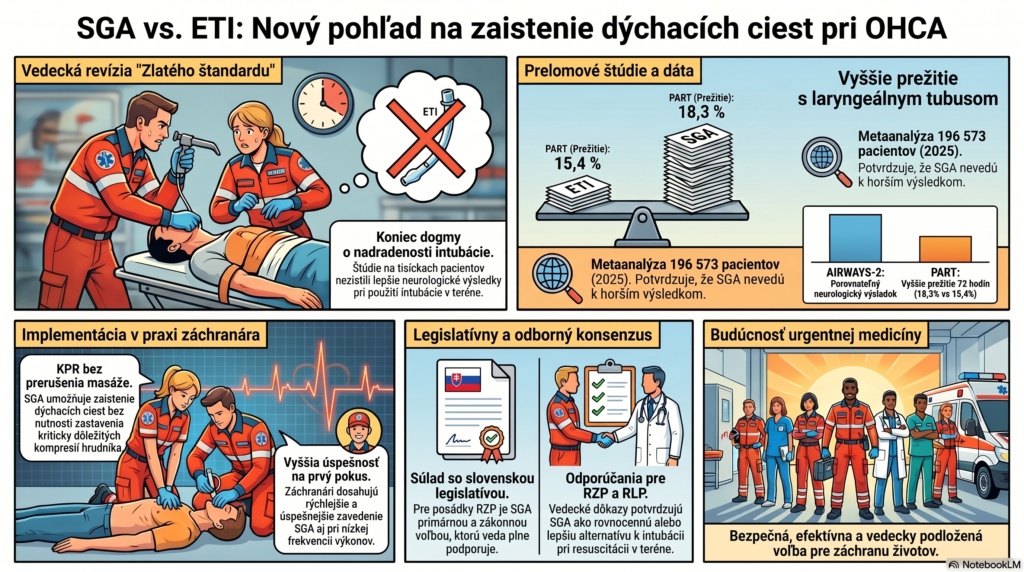
Two large randomized controlled trials — the British AIRWAYS-2 (5,800 patients, i-gel vs. ETI, NHS paramedics) and the American PART (laryngeal tube vs. ETI, North American paramedics) — produced results that definitively shook the dogma of ETI as the unquestioned gold standard in OHCA.
The trial found no statistically significant difference in the primary outcome (modified Rankin Scale at discharge). Paramedics using the i-gel achieved comparable neurological outcomes without needing to interrupt CPR for intubation.
The laryngeal tube was associated with higher 72-hour survival (18.3% vs. 15.4%) compared to ETI. Paramedics using the LT achieved faster first-pass success and fewer CPR interruptions.
A meta-analysis published in 2025 (more than 196,000 patients) further confirms: SGAs don’t lead to worse outcomes than ETI, and in EMS systems without a physician they may even be superior.
Also interesting is the protocol-deviation analysis in AIRWAYS-2: in 11.7% of cases, paramedics didn’t complete the assigned airway strategy — most often due to anatomical difficulty or regurgitation. This points to the reality of the field.
Methodological strength of the evidence
[✓ Cluster RCT — high level] [✓ n = 5,800 (AIRWAYS-2)] [! Open-label design] [✓ 2025 meta-analysis: 196,573 patients]
— Cluster randomization: The crew (paramedic) was randomized, not the patient. This can introduce confounding through individual paramedic experience.
— Different devices: AIRWAYS-2 tested the i-gel, PART the laryngeal tube — results aren’t directly transferable between devices.
— EMS system context: The British and American EMS models differ from the Slovak one — extrapolation requires a critical approach.
— Aspiration: A 2021 systematic review noted that SGAs may be associated with a higher aspiration risk. Newer data are less clear-cut.
Applicability under Slovak conditions
| Parameter | Status in Slovakia (RZP) | Relevance for SGA vs. ETI |
|---|---|---|
| RZP competencies | Slovak Act No. 579/2004 Coll. — a basic-level paramedic (RZP) is not authorized to perform ETI | ✓ SGA is the primary and legally mandated choice for RZP — the ETI vs. SGA debate is settled by law for RZP |
| RLP (physician-crew) competencies | A physician has full authority, including ETI and RSI | ! Still relevant for RLP: even physician-performed ETI in the field isn’t automatically superior |
| Devices on ambulances | The LTS-D (VBM) is the standard device on most RZP ambulances in Slovakia | ✓ Direct applicability of the PART results — the same device category |
| Procedure frequency | An RZP paramedic performs airway management in OHCA relatively sporadically | ✓ Low frequency supports SGA — higher first-pass success without extensive training |
| CPR interruption | Minimizing no-flow time is critical — every second of pause has a cost | ✓ SGA insertion without interrupting compressions is a clear advantage |
| Aspiration | The LTS-D has a drainage channel for a suction catheter — partial protection | ! Not an absolute substitute for ETI — watch for new data |
An RZP paramedic using the LTS-D is doing exactly what the evidence recommends. Further data on aspiration and ventilation leak during mechanical ventilation through an SGA during CPR remain worth watching.
- Benger JR, et al. Effect of a Strategy of a Supraglottic Airway Device vs Tracheal Intubation During Out-of-Hospital Cardiac Arrest on Functional Outcome: The AIRWAYS-2 Randomized Clinical Trial. JAMA. 2018;320(8):779–791.
- Wang HE, et al. Effect of a Strategy of Initial Laryngeal Tube Insertion vs Endotracheal Intubation on 72-Hour Survival in Adults With Out-of-Hospital Cardiac Arrest: A Randomized Clinical Trial (PART). JAMA. 2018;320(8):769–778.
- Benger JR, et al. Supraglottic airway device versus tracheal intubation in the initial airway management of OHCA: the AIRWAYS-2 cluster RCT. Health Technol Assess. 2022;26(21):1–158.
- 2025 meta-analysis: Supraglottic Airway Devices Improve Clinical Outcomes for OHCA: An Updated Systematic Review and Trial Sequential Meta-Analysis Involving 196,573 Patients. medRxiv. 2025.
- Slovak Act No. 579/2004 Coll. on Emergency Medical Services — competencies of the basic-level paramedic (RZP).
- European Resuscitation Council: ERC Guidelines 2021. Resuscitation. 2021;161.
- Garcheva V, et al. Increased rate of anoxic brain damage with laryngeal tube compared to ETI in patients with shockable OHCA — HACORE Registry. Resuscitation. 2024;205:110416.
Paramedic with more than 15 years of experience in prehospital emergency care, RZP Leopoldov. Administrator and editor of zachranarjecool.eu.