We’re There, They’re Here —
interprofessional tension in the EMS system
The field, the emergency department, dispatch: three axes of friction, one chain of care. What the literature says, and what it means for the Slovak EMS system.
One continuum, three courtyards
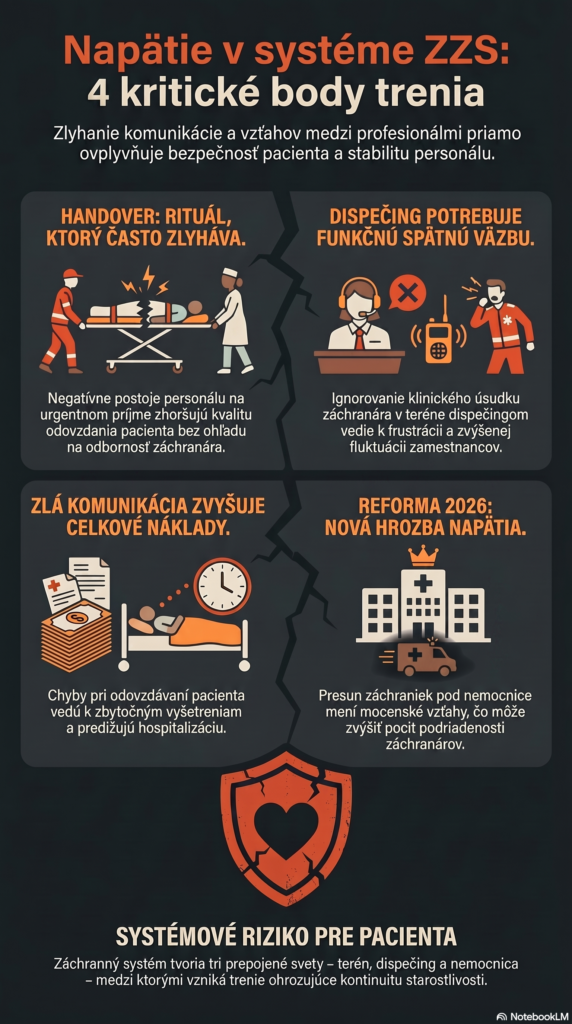
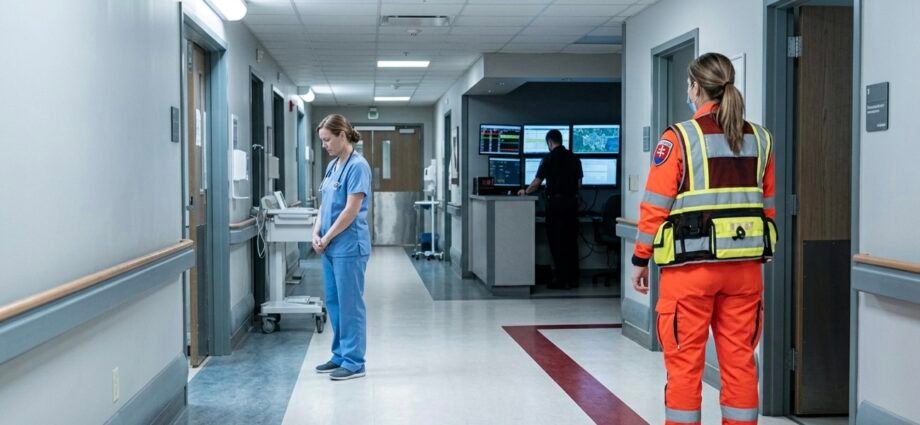
The field paramedic, the emergency department paramedic, and the dispatch center operator all share one goal — save the patient. Yet the daily reality of the Slovak EMS system produces friction at all three interfaces: at patient handoff in the emergency department, in dispatch decisions by the operations center, and in the context of an ongoing structural reform that further destabilizes these relationships.
This Journal Club review doesn’t work with a single primary study, but with three complementary sources that together cover the whole scope of the issue. The intent isn’t to declare who’s right — but to identify where the system creates the conditions for failure.
Patient handoff: the ritual that usually fails
Handoff — transferring the patient from the EMS crew to emergency department staff — is identified in the literature as one of the most vulnerable moments in the chain of care. Not because paramedics don’t know how to hand off. But because the system doesn’t create the conditions for it.
Patient handover between ambulance crew and healthcare professionals in Icelandic emergency departments: a qualitative study
Ragnarsdóttir et al. · Scandinavian Journal of Trauma, Resuscitation and Emergency Medicine · 2021
Design: A qualitative study (Vancouver School phenomenological method). In-depth interviews with both paramedics and emergency department staff. Iceland — a system close to the Central European model.
Key finding: Both paramedics and nurses consistently identified that negative attitudes and interprofessional tension between healthcare professions directly affect the quality of patient handoff — and therefore the patient’s fate. The tension exists independently of the quality of the information handed over. This is a relational, not a technical, dysfunction.
The satisfaction regarding handovers between ambulance and emergency department nurses
Hovenkamp et al. · Scandinavian Journal of Trauma, Resuscitation and Emergency Medicine · 2018
Design: A prospective observational study, 97 handoffs, UMCG Groningen. Questionnaire-based satisfaction assessment on a 5-point scale.
Key correlations: Paramedic satisfaction correlated negatively with waiting time before handoff (r = −0.287; p = 0.004). Emergency department nurse satisfaction correlated positively with using the ABCDE structure during handoff (r = 0.288; p = 0.006). The presence of a physician during handoff increased paramedic satisfaction (r = 0.224; p = 0.028).
The paramedic waits with the patient for handoff — the crew is tied up, another patient is waiting somewhere else for a response. Every minute of waiting reduces the paramedic’s satisfaction and worsens focus during the handoff itself.
A multicenter study of 721 handoffs (ISBAR, MIST, BAUM) found a deficit in structure and content in 99.4% of cases. Patient age was stated in 47%, and the time of event onset in only 37.7% of handoffs.
Miscommunication at handoff increases system costs through unnecessary diagnostic tests, extended hospitalizations, and preventable readmissions (Dawson et al., cited in Tortosa-Alted 2025).
Interprofessional tension isn’t the result of a poor handoff — tension itself worsens the handoff. It’s a feedback loop that protocol standardization alone won’t break.
“Negative attitudes and tension between healthcare professions can affect the quality of patient handover.”
Ragnarsdóttir et al., 2021 · Scand J Trauma Resusc Emerg MedThe dispatcher and the paramedic: who sees the patient better?
Under Slovak Act No. 579/2004 Coll., the regional operations center coordinates the entire EMS response — the dispatcher assigns calls, sets priority, manages crews. The field paramedic has the patient in front of them. This is the fundamental structural tension of the second axis: an information asymmetry accompanied by an authority asymmetry.
Role identities of emergency medical services personnel and their associations with intention to leave the profession
Murtola et al. · BMC Emergency Medicine · 2024
Design: A cross-sectional survey study (N = 616, Finland). The EMS Role Identity Scale — four dimensions: caregiving, thrill-seeking, duty, and capacity. Binary logistic regression for intention to leave the profession.
Key finding: Paramedics emphasize different aspects of their professional identity — and these differences in identity relate directly to the degree of conflict within the system and to the likelihood of leaving the profession. Paramedics with a strong “capacity” orientation show the highest tension in settings where their clinical judgment isn’t validated by external actors, including dispatch.
The Finnish study also points to a broader context: the scope of paramedic practice has expanded significantly in recent decades — encompassing increasingly complex interventions, a holistic view of the patient, and high-level clinical decision-making. This creates tension when the management system (dispatch) works with protocol-based algorithms that don’t account for this expansion.
The paramedic sees the patient. The dispatcher sees the system. When these views collide without a feedback mechanism, the result is frustrating communication — and in worse cases, a clinical error.
Research shows that automated dispatch protocols (MPDS) identify more critical cases than dispatchers’ subjective override decisions. The override feature should remain for exceptions, not become the norm.
Paramedics whose professional identity is built on competence are more likely to leave the profession if the system fails to recognize that competence long-term. Dispatch is one of the places where this recognition is given — or withheld.
The Slovak EMS Operations Center is a state contributory organization under the Ministry of Health. Dispatch operators work 24/7 on the emergency line. A formalized feedback mechanism from paramedics to dispatch decision-making is lacking — a systemic gap.
EMS under hospital authority: reform as a catalyst for tension
In January 2026, Slovakia’s Minister of Health presented a plan to place emergency medical services under the authority of hospitals with emergency departments. Three possible operating models, with responsibility always resting with the hospital. The Association of Hospitals of Slovakia supported the plan. The Slovak Chamber of Paramedics protested immediately.
| Party | Position | Main argument |
|---|---|---|
| Ministry of Health / Hospital Association | Pro-reform | System stability, better patient management, integration of the care chain |
| Chamber of Paramedics | Against | Threat to provider plurality, declining quality, degradation of training, risk of state EMS units closing |
| EMS unions | Critically skeptical | Hospitals’ lack of understanding of the EMS system, lack of respect for paramedics’ work, risk of reduced motivation and turnover |
| Field paramedics | Divided | Some welcomed the change, others fear losing professional autonomy and being subordinated to hospital hierarchy |
From an interprofessional-dynamics perspective, the key question isn’t legislative but relational: the reform changes power relationships. A paramedic who today hands off a patient as an equal healthcare professional could find themselves in an organizational subordinate position to the hospital whose staff had until now been their “partner” at handoff. That doesn’t reduce the tension on axis #1 — it’s more likely to increase it.
“If paramedics are given no space for feedback, you risk a significant decline in their motivation, an erosion of trust in management, and the emergence of conflict.”
An EMS union statement · January 2026Strength and limits of the available evidence
Interprofessional tension in the EMS system is well described in the international literature — but the Slovak context is almost entirely unstudied. There is no published qualitative or quantitative analysis of tension among Slovak EMS field paramedics, emergency department staff, and operations center dispatchers. This is a first-order research gap.
The Icelandic study (Ragnarsdóttir 2021) is methodologically most relevant to axis #1 — its qualitative design captures relational dynamics that quantitative studies don’t see. The Finnish study (Murtola 2024) is relevant to axis #2, even though the Finnish dispatch system is organized differently. Hovenkamp (2018) adds quantitative grounding for handoff satisfaction.
What this means for the Slovak field
The literature doesn’t give us a prescription, but it identifies points of systemic failure. In the Slovak EMS context, this translates into concrete recommendations:
- Axis #1 — Handoff: Introducing a standardized handoff protocol (MIST/ISBAR) isn’t just a technical matter — without addressing relational tension, protocol alone isn’t enough. Interprofessional education (joint training for EMS paramedics and emergency department staff) is supported by the research.
- Axis #2 — Dispatch: The system needs a formalized feedback mechanism from paramedics toward the operations center. Without it, a field paramedic’s clinical judgment remains organizationally invisible — directly threatening professional identity and increasing turnover risk.
- Axis #3 — Reform: Integrating EMS under hospitals can reduce organizational friction at handoff — but only if relational and power aspects are addressed, not just legislative ones. Reform without an interprofessional program can deepen the tension.
- Research priority: Slovakia needs its own qualitative study of interprofessional dynamics in EMS — field paramedics, dispatch operators, and emergency department staff. This is a legitimate subject for academic or Chamber of Paramedics-led research output.
References