Introduction: The Seconds That Decide
Imagine this situation: you’re a member of a two-person Basic Life Support (RZP) crew. In a cramped space, under enormous pressure and with limited staffing resources, you’re fighting for the life of a critically ill patient. Airway management in this environment is one of the most cognitively demanding tasks there is. The traditional idea that the only path to saving the patient is inserting a tube into the trachea, however, runs into reality in the modern context. Must every critically ill patient be intubated to survive? The answer, backed by scientific evidence, fundamentally changes how we view tactical procedure in the field.
The myth of perfect intubation: Oxygenation is more than technique
In the RZP environment, where there’s no physician and no possibility of pharmacologically induced sequence, priorities shift. The goal isn’t to demonstrate technical virtuosity at endotracheal intubation (ETI), but to ensure the patient’s survival. Slovak legislation, specifically Decree of the Slovak Ministry of Health No. 321/2005 Coll., clearly defines a paramedic’s competencies: secure the airway without using a laryngoscope under direct visual control. This directs us toward using basic airway adjuncts and second-generation supraglottic airway devices.
“The goal of airway management on a basic-level EMS crew isn’t performing a technically complicated endotracheal intubation (ETI), but immediately achieving and maintaining effective alveolar oxygenation and ventilation.”
Game-changing evidence: The AIRWAYS-2 and PART studies
The debate over whether supraglottic airway devices (SGAs) are safe enough has been settled by large randomized trials. Their results brought breakthrough data:
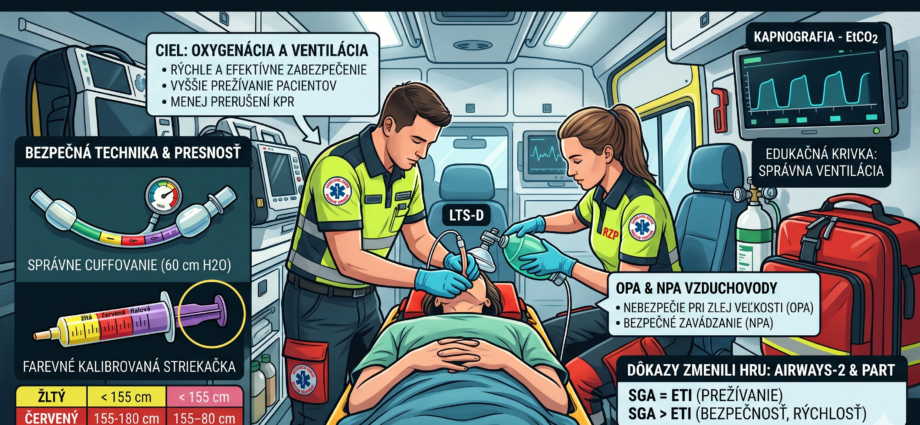
- AIRWAYS-2: This trial, in a sample of more than 9,000 patients after out-of-hospital cardiac arrest (OHCA), showed that the chances of survival with a good neurological outcome are identical with SGA use compared to classic intubation.
- The PART trial: Focused directly on laryngeal tubes, it even showed significantly better 7-day survival in patients where a laryngeal tube was used instead of ETI.
The reason is pragmatic: the “blind technique” of the laryngeal tube is safer, faster in a two-person team, and dramatically reduces the number of unwanted interruptions to chest compressions. It lets paramedics maintain a Chest Compression Fraction (CCF) above 80%, which is an absolute priority during resuscitation.
The laryngeal tube: The standard of Slovak emergency medicine
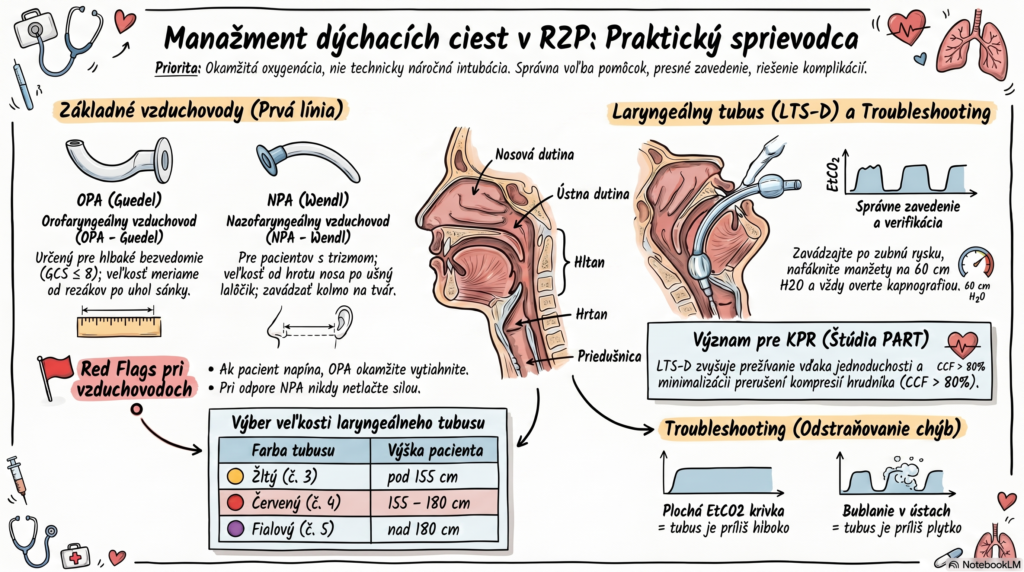
The second-generation laryngeal tube (LTS-D) is a key tool for the paramedic. Its ingenuity lies in the construction of two cuffs — the distal one seals off the esophagus, and the proximal one fills the pharynx. It also has a drainage channel for a gastric tube (size Ch 16–18), enabling critically important gastric decompression.
As an expert, you must master precise size selection based on the patient’s height, not “by eye”:
| Tube color and number | Patient height |
|---|---|
| Yellow (No. 3) | under 155 cm |
| Red (No. 4) | 155 – 180 cm |
| Purple (No. 5) | over 180 cm |
The “by eye” trap: Critical technique failures
Even the best device can fail if it isn’t inserted with anatomical understanding. You must recognize these critical failure points:
- Oropharyngeal airway (OPA): If you choose too long a size, you’ll push the epiglottis down over the laryngeal inlet, paradoxically closing the airway completely. With a preserved reflex, this risks laryngospasm and vomiting.
- Nasopharyngeal airway (NPA): Insert the tube strictly perpendicular to the face (along the floor of the nasal cavity). Never force it against resistance — you risk massive nasopharyngeal bleeding and subsequent blood aspiration.
- Laryngeal tube (LTS-D) and cuff inflation: Inflating the cuffs “by eye” is unacceptable in modern medicine. Use only a color-calibrated syringe set to 60 cm H2O pressure.
- Warning: Excessive pressure (over-cuffing) will cause the tube to push itself out under its own pressure. Insufficient pressure, on the other hand, leads to an air leak and ineffective ventilation.
Capnography: The paramedic’s only true compass
Waveform capnography (EtCO2) isn’t a luxury — it’s an absolute condition for success. It’s the only objective proof of correct placement and effective ventilation. When working with the LTS-D, you must immediately diagnose and address these conditions:
- A flat EtCO2 waveform + high resistance: The tube is inserted too deep. The distal cuff has passed into the larynx or rolled the epiglottis. Solution: Deflate the cuffs, withdraw the tube 1–2 cm, and re-verify ventilation.
- Bubbling at the mouth + air leak: The tube is too shallow or over-cuffed. Solution: Deflate the cuffs, advance the tube exactly to the indicated tooth-line mark, and inflate per the calibrated syringe.
- A sudden EtCO2 drop during transport: The tube has become dislodged during manipulation. Solution: Check the mark’s position. If repositioning doesn’t help, remove the tube, switch to bag-mask ventilation, and reinsert it.
Conclusion: Pragmatism wins over dogma
Airway management on a basic-level EMS crew must be pragmatic, fast, and safe. Modern prehospital care is stepping away from the dogma that every critically ill patient must unconditionally be intubated with an endotracheal tube. For the paramedic, the LTS-D and basic airway adjuncts are highly effective tools that, with technical discipline, save lives just as successfully as ETI.
Are we, as a professional community, ready to abandon the old dogma about intubation in favor of higher survival for our patients? The answer lies in our technical precision — in every single cuff inflation per the calibrated syringe, and in every single waveform on the capnograph. Pragmatism and discipline matter more in the field than technical complexity.
References
- Decree of the Slovak Ministry of Health No. 321/2005 Coll. on the scope of practice in healthcare professions, as amended.
- European Resuscitation Council (ERC) Guidelines 2021: Advanced Life Support (ALS) / Prehospital airway management.
- BENGER, J. R., et al. (2018): Effect of a Strategy of a Supraglottic Airway Device vs Tracheal Intubation on Clinically Favorable Functional Outcome in Out-of-Hospital Cardiac Arrest: A Randomized Clinical Trial (AIRWAYS-2). The Lancet, 392(10150), 221-231.
- WANG, H. E., et al. (2018): Effect of a Strategy of Initial Laryngeal Tube Insertion vs Endotracheal Intubation on 7-Day Survival for Patients With Out-of-Hospital Cardiac Arrest: The PART Randomized Clinical Trial. JAMA, 320(8), 769–778.
- CHRIMES, N. (2016): The Vortex Approach: a management tool for unpredictable difficult airway situations. British Journal of Anaesthesia, 117, i20–i27.