Imagine this situation: You’re a professional paramedic — emergency medicine and crisis management are your lifelong profession and your passion — and right in your home village, the base camp for one of the most significant international tactical exercises of the year sets up: Field Training Exercise (FTX) 2026.
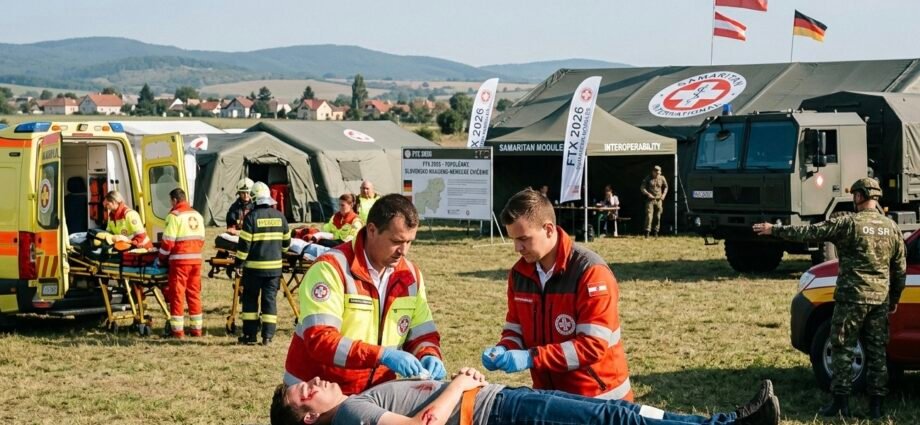
From May 12 to 17, 2026, Veľké Ripňany and the surrounding villages of the Topoľčany district turned into tactical operational zones. Samaritan rapid-deployment modules from Slovakia, Austria, and Germany simulated deployment for a large-scale natural disaster in a 24/7 regime. As a paramedic, I had a unique opportunity to watch this colossus in action. But for objective reasons, I couldn’t take part as an official observer inside the structures.
Although I was immensely sorry that I couldn’t bring you at zachranarjecool.eu an exclusive in-depth analysis built on internal data, as paramedics within the IZS system we know well that an outside view can also define the most pressing questions. I firmly believe the official analysis and “Lessons Learned” will one day be accessible to our whole community. Until then, let’s look at everything FTX 2026 tested and why these outputs are literally invaluable for the Slovak Integrated Rescue System (IZS).
What did we want (and need) to analyze?
Mass-casualty (MASCAL) response and disaster medicine follow completely different rules than ordinary daily ambulance practice. If we had access to the exercise’s internal statistics, here are 4 key areas that would move our community forward:
1. Validating triage protocols under extreme pressure
For the first EMS crews at the scene of a disaster, triage is everything. FTX 2026 simulated a massive influx of injured in the villages of Prašice and Malé Ripňany. The following data would be key for IZS practice:
Throughput of triage stations: How quickly could paramedics apply triage algorithms (e.g., the standardized START or SieVAM method used here) under difficult conditions?
Error rate (over-/under-triage): How many patients were overtriaged (which in practice burdens transport) and how many undertriaged (which immediately threatens life)?
2. Data flow and radio communication (EMS Operations Center vs. international modules)
Communication failure is the most common cause of management collapse in real disasters. The exercise tested cross-border cooperation, which raises important questions:
Technical interoperability: How well did our encrypted Sitno network technically connect with the communication resources of the Austrian and German Samaritan modules?
Language barrier and unification: How well did patient handoff using MIST or SBAR protocols work under pressure and in a foreign language? Loss of information during the prehospital phase can be fatal.
3. Evacuation logistics and civil-military cooperation (CIMIC)
When EMS capacity hits its limit, other components step in. FTX 2026 showed massive integration: from the Crisis Management Department of the Topoľčany District Office, through the Fire and Rescue Corps (using boats for flooding), to the 1st Mechanized Brigade of the Armed Forces of the Slovak Republic.
For a paramedic in the field, it’s critical to know how effectively the Base of Operations (BoO) management functioned and how patient flow to the surrounding emergency departments (Topoľčany, Nitra, Partizánske) was regulated so they weren’t immediately overwhelmed.
4. Sleep deprivation and psychological resilience
An ordinary call lasts hours; this exercise lasted 6 days in a 24/7 regime.
Tracking the effect of sleep deprivation on paramedics’ clinical decision-making and the actual field deployment of post-traumatic support teams — this is information that should shape shift scheduling and psychological preparation of personnel across the whole IZS system.
Conclusion: A lesson in preparedness
Although this time you won’t find tables and charts from the actual exercise on our site, FTX 2026 gave us an important indirect lesson. It showed us that success in disaster recovery doesn’t depend on isolated individual clinical skills, but on strict adherence to incident command procedures and logistical self-sufficiency.
Disaster medicine isn’t about improvisation; it’s about a perfectly rehearsed system. And I firmly believe the data from this exercise will one day reach all of us who serve in this system every day.
What do you think about international exercises like this? Have you already encountered the need for international cooperation within IZS in practice? Write in the comments.