Introduction
Altered levels of consciousness are among the most common, and at the same time the most complex, conditions in emergency medicine. For a paramedic in the field, an altered level of consciousness is not itself a diagnosis, but a symptom that can mask a wide range of etiologies — from reversible metabolic derangements to fatal intracranial catastrophes. In prehospital care, the key to success is a systematic approach, rapid stabilization of vital functions, and early differential diagnosis focused on reversible causes.
1. Terminology and classification
We define consciousness as a state of wakefulness (arousal) combined with a preserved ability to perceive, process, and adequately respond to stimuli (awareness).
Quantitative disorders (disorders of arousal):
• Somnolence: The patient is asleep but can be woken by verbal stimulus, and speech is coherent.
• Stupor: Responds only to a strong (painful) stimulus, with an inadequate or purely motor (withdrawal) response.
• Coma: No response to painful stimulus, brainstem reflexes fade. GCS 3 to 8.
Qualitative disorders (disorders of content):
• Confusion: Disorientation to time, place, and person, with an inability to synthesize perceptions.
• Delirium: An acute state with motor agitation, hallucinations, and autonomic symptoms.
• Clouding of consciousness (twilight state): Sudden onset and resolution, with amnesia for the event (typical of postictal states).
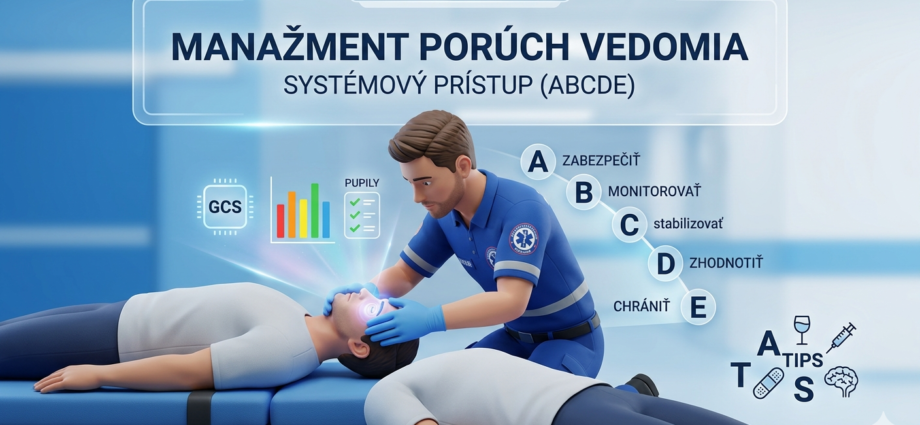
2. Diagnostic algorithm and practical skills (ABCDE)
The foundation is the primary survey methodology, where each abnormality must be addressed before moving to the next point.
A – Airway
When GCS drops to 8 or below, protective laryngeal reflexes are lost.
• Skill: Manual airway opening. Use of the jaw-thrust maneuver (especially with suspected cervical spine trauma).
• Skill: Adjuncts. Placement of an oropharyngeal (Guedel) airway. For deep unconsciousness, consider a supraglottic airway (laryngeal mask/tube), which is within EMS crew scope of practice.
B – Breathing
• Skill: Auscultation and monitoring. Assessing respiratory rate and pattern (e.g., Cheyne-Stokes breathing). Mandatory SpO2 monitoring and capnometry (EtCO2).
• Skill: Oxygen therapy. Applying O2 via a non-rebreather mask (flow 10–15 l/min) in a critical patient.
C – Circulation
• Skill: 12-lead ECG. Ruling out arrhythmia or MI as a cause of cerebral hypoperfusion.
• Skill: IV/IO access. Establishing peripheral venous access. If IV access is not achieved within 90 seconds, an intraosseous access device (e.g., an EZ-IO drill) is indicated.
D – Disability (neurological status)
• Skill: Glasgow Coma Scale (GCS). Standardized scoring (3–15 points).
• Skill: Pupillometry. Assessing symmetry (anisocoria), size, and light reactivity.
• Skill: Blood glucose. Mandatory in every patient with an altered level of consciousness.
3. Differential diagnosis (AEIOU TIPS)
• A – Alcohol / Acidosis: Fetor on the breath, but watch for head trauma. Kussmaul breathing and low EtCO2 in ketoacidosis.
• E – Epilepsy / Endocrine: Postictal depression, lateralization, urinary incontinence, or tongue-biting.
• I – Insulin: Hypoglycemia. The most common reversible cause. For glucose below 3.3 mmol/l, give IV glucose.
• O – Overdose / Oxygen: Opioid intoxication (miosis, bradypnea). Titrated naloxone administration. Hypoxia from asphyxiation.
• U – Uremia: Metabolic failure (look for a dialysis shunt or jaundice).
• T – Trauma / Temperature: Examine the scalp for hematomas. Hypothermia or heatstroke.
• I – Infection: Meningeal signs, fever, petechiae (sepsis).
• P – Poisoning / Psychogenic: CO poisoning, psychogenic unresponsiveness.
• S – Stroke / Shock: Stroke (FAST test). Shock (MAP below 65 mmHg) causes cerebral hypoperfusion.
Conclusion
Managing altered levels of consciousness requires analytical thinking from the paramedic. The priority remains maintaining airway patency and oxygenation. Every procedure must be performed lege artis, in line with scope of practice and current ERC recommendations.
Sources:
1. Slovak Ministry of Health Decree No. 321/2005 Coll. on scope of practice.
2. Slovak EMS Operations Center Standard Operating Procedures.
3. ERC Guidelines 2021/2025 (ALS procedures).
4. Dobiáš, V.: Emergency Healthcare, 2021.