Introduction
Burn trauma is one of the most devastating types of injury, requiring an immediate and systematic approach. For a paramedic in the field, the key to success is not only accurately assessing the depth and extent of the burn, but above all preventing the development of burn shock, early airway management (in inhalation injury), and adequate analgesia. We always proceed according to the ABCDE framework, with stopping the burning process and stabilizing vital functions as the priority.
1. Types and classification of burns
Burns are classified by etiology (cause) and by depth of tissue damage.
A. Classification by etiology (cause):
• Thermal: Contact with flame, hot liquids (scalding), steam, or hot objects.
• Electrical: Exposure to electric current (low- or high-voltage) or lightning. Watch for entry and exit wounds and the risk of arrhythmias.
• Chemical: Exposure to acids (coagulation necrosis) or alkalis (liquefactive necrosis — deeper and more severe).
• Radiation: Exposure to UV radiation (sun) or ionizing radiation.
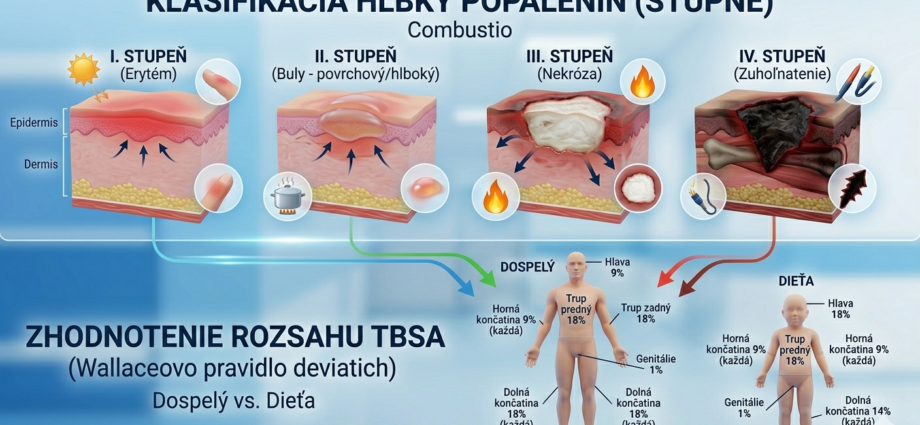
B. Classification by depth of injury:
• First degree (superficial burn):
• Clinical picture: Redness (erythema), pain, swelling, no blisters (e.g., sunburn). Only the epidermis is affected.
• Healing: Spontaneous, within 5–7 days, no scarring.
• Second degree (partial-thickness burn):
• Subdivided into:
• Superficial partial-thickness: Epidermis and superficial dermis affected.
• Clinical picture: Blisters filled with clear fluid, the wound bed is red, moist, and severely painful (sensory nerves preserved).
• Healing: Spontaneous, within 2–3 weeks, usually without scarring.
• Deep partial-thickness: Epidermis and deep (reticular) dermis affected.
• Clinical picture: Blisters, the wound bed is pale pink to white, less painful (nerves partially damaged).
• Healing: Prolonged (3–6 weeks), often with hypertrophic scarring, infection risk.
• Third degree (full-thickness burn):
• Clinical picture: Complete destruction of the epidermis and dermis. Tissue is firm, waxy-white, brown to black (necrosis/eschar), and painless to touch (nerve endings completely destroyed).
• Healing: Spontaneous healing not possible (only from the edges), surgery required (necrectomy and skin grafting).
• Fourth degree:
• Clinical picture: Injury extends into subcutaneous tissue, fascia, muscle, tendons, and bone (charring).
2. Prehospital first aid (initial management)
The priority is stopping the burning process and stabilizing the patient.
A. Stopping the burning process:
• Scene safety first! (Watch for smoke, chemicals, electricity.)
• Removing the source: Getting the patient out of a smoke-filled space, extinguishing burning clothing (smothering with a blanket, having the patient roll on the ground).
• Skill: Cooling. The most effective method for relieving pain and stopping the spread of heat deeper into tissue.
• Cool with sterile saline, clean water (in the field), or hydrogel dressings (e.g., BurnJel).
• Only cool first- and second-degree burns, and only up to a maximum of 20% TBSA in adults (10% in children), for no more than 20 minutes.
• Warning: hypothermia risk. Never cool the entire body! Never use ice (risk of frostbite injury).
• Removing contaminated clothing: Remove wet clothing or clothing soaked with chemicals. Rule: Never remove clothing melted/fused to the wound! Also remove jewelry, rings, and watches (risk of constriction as edema develops).
B. Primary survey (ABCDE):
• A (Airway): Priority management with suspected inhalation injury.
• Signs of inhalation injury: Injury in an enclosed space, singed eyebrows/hair, soot in sputum, hoarseness, stridor, burns of the face and neck.
• Skill: Immediate administration of 100% O2 via a non-rebreather mask. Early orotracheal intubation before massive laryngeal edema develops.
• B (Breathing): Monitor respiratory rate. Inhalation injury carries a risk of developing bronchospasm and pulmonary edema.
• Warning: CO and cyanide poisoning. SpO2 saturation is unreliable (reads high even during intoxication). The crew must monitor clinical status and EtCO2.
• C (Circulation): Monitor blood pressure and pulse. Establish two large-bore peripheral IV lines (14G/16G) through unburned skin if possible (if not, through burned skin or via intraosseous access).
• D (Disability): GCS, blood glucose.
• E (Exposure): Assess burn extent using the Wallace “rule of nines” (note: the head-to-limb ratio differs in children). Mandatory body temperature monitoring.
3. Ongoing care in the ambulance (specific treatment)
In the ambulance, focus shifts to shock prevention and transport.
A. Fluid resuscitation (burn shock prevention):
• Indication: Burns over 15–20% TBSA in adults and over 10% TBSA in children (deep partial- or full-thickness).
• Skill: The Parkland formula.
• In the field, in the first hour, give: Adults — a bolus of 1000 ml crystalloid (normal saline or Ringer’s); children — 20 ml/kg.
• Full calculation: 4 ml × kg × %TBSA (total dose over 24 hours). Half is given in the first 8 hours from the time of injury.
B. Analgesia and sedation:
• Rule: Every burn is painful. Analgesia must be prompt and adequate.
• Route of administration: Strictly intravenous — intramuscular injection is ineffective due to impaired tissue perfusion.
• Pharmacotherapy (per protocol):
• Fentanyl (adult 50–100 mcg IV; child 1 mcg/kg IV) — first-line drug, minimal hemodynamic impact.
• Sufentanil (titrated IV).
• Ketamine (in combination with midazolam) — especially for severe trauma.
C. Local wound care and transport:
• Skill: Sterile dressing. Cover the burned area with a sterile, non-adherent dressing or a specialized hydrogel dressing.
• Rule: Never puncture blisters in the field! Never apply any ointments or creams to a burn.
• Hypothermia prevention: Wrap patients with burns over 10% TBSA thoroughly in a thermal blanket and covers. Turn on the heat in the ambulance.
• Transport destination: To the nearest trauma center; for critical burns (over 20% TBSA in adults / 10% in children, inhalation injury, burns of the face, hands, or genitals), direct to a specialized Burns and Reconstructive Surgery Clinic.
Conclusion
Burn management in prehospital care requires from the paramedic not only precise technical skill (establishing IV access, intubation for inhalation injury), but also the ability to think quickly and analytically to prevent fatal complications (hypothermia, shock development). The priority remains stopping the burning process, adequate analgesia, and early fluid resuscitation, minimizing the risk of secondary tissue damage.
Sources and legal basis:
1. Slovak Ministry of Health Decree No. 321/2005 Coll. on scope of practice (EMS crew competencies).
2. Slovak EMS Operations Center Standard Operating Procedures — burn trauma management.
3. Clinical recommendations for burn management (European Burns Association).
4. Dobiáš, V. et al.: Emergency Healthcare (Osveta, 2021).