Introduction Glucose (grape sugar) is a fundamental energy substrate for cells, particularly for the brain. In emergency medicine its parenteral administration is a life-saving intervention for severe hypoglycemia, which, if untreated, leads to irreversible brain damage and death. Glucose is also used as a carrier solution for other drugs and for mild rehydration.
1. Drug Identification
- Active substance: Glucosum (as the monohydrate).
- Trade names in Slovakia: Glucose (5%, 10%, 20%, 40% solutions).
- ATC classification: V06DC01 (Carbohydrates, glucose), B05BA03 (Solutions for parenteral nutrition).
- Dosage forms and concentrations in EMS:
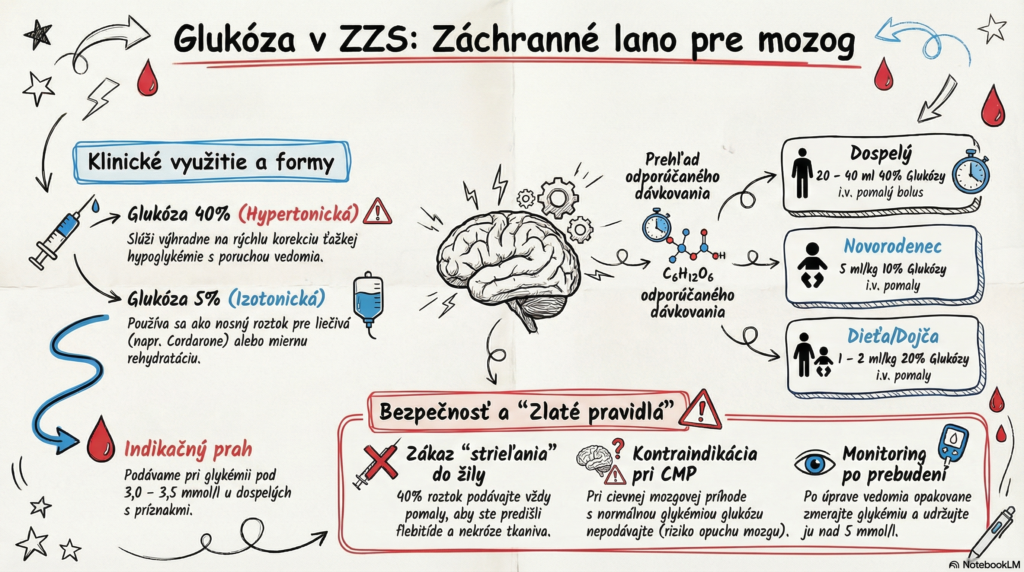
- Glucose 40%: Injection solution (ampules, most commonly 10 ml or 20 ml) — used to correct hypoglycemia.
- Glucose 5%: Infusion solution (bottles, most commonly 100 ml, 250 ml, 500 ml) — used as a carrier solution for medications, mild rehydration, and protecting the airway after intubation.
- Glucose 10%, 20%: Injection/infusion solution (less common in standard ambulances).
2. Mechanism of Action (Pharmacodynamics)
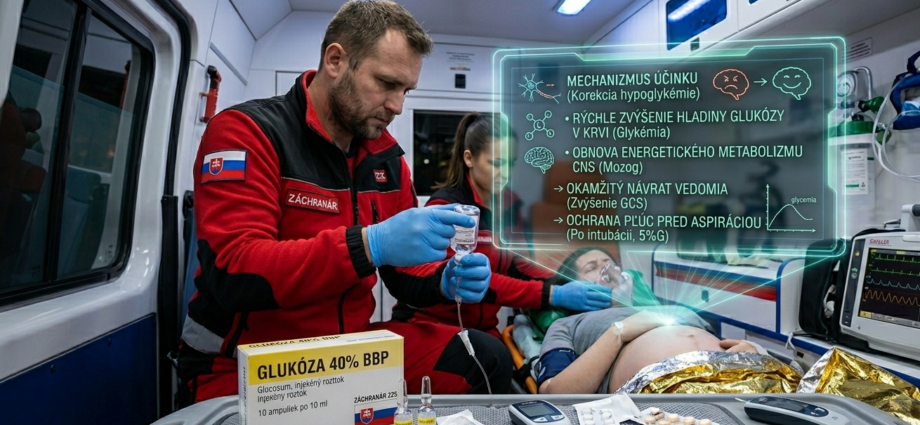
- Energy substrate: After IV administration, immediately raises plasma glucose concentration (glycemia). Glucose enters cells (particularly neurons) via facilitated diffusion, where it’s converted to energy (ATP) through glycolysis and the Krebs cycle.
- Osmodiuretic effect: At higher concentrations (40%), it has osmotic pressure that draws water from the interstitial space, mildly reducing intracranial pressure.
- Mild rehydration (5% glucose): Isotonic, and once metabolized, leaves “free water” in circulation that distributes into all compartments, mildly rehydrating cells.
3. Hemodynamic Effects – IN DETAIL
- BP and HR: No direct effect.
- Metabolic effect: Increases pancreatic insulin production and shifts potassium into cells, which can cause mild hypokalemia (used therapeutically in treating severe hyperkalemia).
4. Pharmacokinetics (from a Paramedic’s Perspective)
- Route of administration: Exclusively IV (slowly!, to avoid osmotic damage to the vein).
- Onset of action: When correcting hypoglycemia, nearly immediate (within 5 minutes). A patient in hypoglycemic coma may “wake up” during administration of a 40% glucose bolus.
- Peak effect: Immediately after administration.
- Distribution: Throughout the whole body, particularly in the CNS.
5. Main Indications in EMS
- Severe hypoglycemia: (Glycemia below 3.0–3.5 mmol/l in an adult, or below 2.5 mmol/l in a neonate) with impaired consciousness, seizures, or focal neurological deficits.
- Correction of mild hypoglycemia: (If the patient is breathing and cooperative, oral glucose tablets or a drink are preferred).
- Carrier solution: For drugs incompatible with normal saline (e.g., amiodarone).
- Mild rehydration: (E.g., in neonates with respiratory distress).
- Airway protection: 5% glucose is given IV after intubation to protect the lungs from aspiration of acidic gastric contents.
6. Dosing in EMS (Golden Rules)
- Correcting hypoglycemia:
- Adult (bolus): 20 ml to 40 ml of 40% glucose IV (i.e., 8–16 g glucose), given slowly. If consciousness doesn’t return within 5 minutes, repeat the dose.
- Adult (infusion): After the bolus, continue with a 5% or 10% glucose infusion, particularly in patients who took oral antidiabetics, to prevent recurrent hypoglycemia.
- Pediatrics (neonates): 5 ml/kg of 10% glucose IV.
- Pediatrics (infants and children): 1–2 ml/kg of 20% glucose IV (or diluted 40% glucose).
- Technique: With 40% glucose, ideally use a central venous catheter or a large peripheral vein to prevent irritation and phlebitis.
7. Contraindications (When Not to Give Glucose)
- Relative: Hyperglycemia, severe dehydration (use crystalloids instead), decompensated diabetes (hyperosmolar syndrome).
- In severe hypoglycemia, there are no contraindications to giving the life-saving dose.
8. Adverse Effects
- Local: Irritation and phlebitis at the injection site with 40% glucose (give slowly!). Extravasation of the 40% solution can cause tissue necrosis.
- Metabolic: Hyperglycemia, hyperglycemic hyperosmolar syndrome.
- Other: Hypokalemia (with high doses).
9. Drug Interactions in EMS
- Carrier solution: Amiodarone must be diluted exclusively in 5% glucose.
- Insulin: Insulin combined with glucose shifts potassium into cells.
10. Specifics for the Paramedic
- Error #1: “Pushing” it in. A rapid bolus of the 40% solution damages the vein and causes phlebitis. Administer slowly!
- Error #2: Insufficient monitoring. Once the patient wakes, glycemia must be measured again to confirm the value is stable (above 5 mmol/l).
- Oral correction: If the patient is communicating, protecting their airway, and breathing, prefer oral glucose tablets.
- Stroke: In a stroke with impaired consciousness but normal glycemia, avoid giving 40% glucose (it can worsen osmotic cerebral edema).
Professional Literature and Sources
- Dobiáš, V. et al. (2021): Emergency Healthcare. Osveta.
- Šuleková, M., et al. (2023): Pharmacology for Paramedics. Bratislava: Herba.
- Pohanka, M. (2025): Clinical Toxicology for Paramedic Studies.
- SmPC – Glucose injection/infusion solution. Slovak State Institute for Drug Control (ŠÚKL).
- ISRCTN (2024): Hypoglycemia management in emergency medicine.