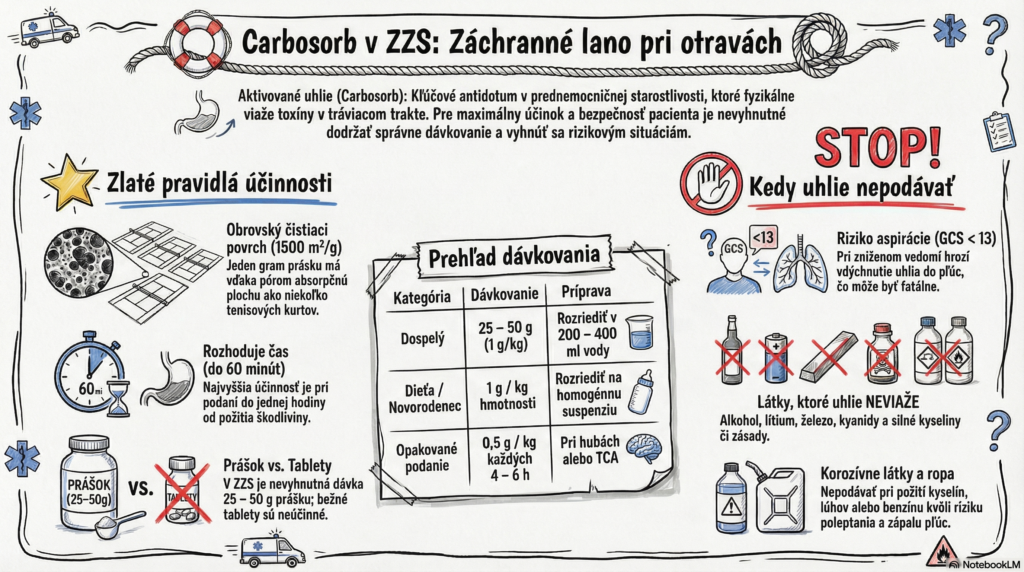
Introduction Activated charcoal is a key therapeutic agent in prehospital toxicology. It’s an inert substance with an enormous internal surface area (up to 1,500 square meters per gram of powder) that physically binds (adsorbs) a broad spectrum of toxins in the digestive tract. In emergency medicine it’s the most effective tool for gastric decontamination after oral ingestion of poisons, medications, or toxic mushrooms.
1. Drug Identification
- Active substance: Carbo activatus (activated charcoal).
- Trade name in Slovakia: Carbosorb (powder for oral suspension).
- ATC classification: A07BA01 (Intestinal adsorbents).
- Dosage form in EMS: 25 g or 50 g powder in a polyethylene bottle (to dilute with water).
- Pharmacological group: Antidote, adsorbent.
2. Mechanism of Action (Pharmacodynamics) Charcoal works exclusively through a physicochemical process:
- Adsorption: A process in which toxin molecules bind to the vast surface and pores of the charcoal via Van der Waals forces. This prevents their absorption from the stomach and intestine into systemic circulation.
- Interruption of enterohepatic and enteroenteric circulation: Charcoal can bind toxins that are excreted into the gut via bile or pass back from blood into the gut (so-called “gastrointestinal dialysis”). This is key in poisonings with a long half-life (e.g., methotrexate, theophylline).
3. Main Indications in EMS
- Acute oral drug poisoning: Paracetamol, tricyclic antidepressants (TCAs), benzodiazepines, beta-blockers, calcium channel blockers, antiepileptics, salicylates.
- Toxic mushroom poisoning: Key in death cap (Amanita phalloides) poisoning, where repeated dosing is also recommended.
- Acute poisoning with other chemicals: Many organic compounds and pesticides.
4. Dosing in EMS (Golden Rules)
- Time factor: Highest effectiveness comes with administration within 60 minutes of ingesting the harmful substance. After 2 hours, effectiveness drops sharply, except for substances that slow GI motility (e.g., TCAs, opioids).
- Dosing principle: A high initial dose is preferred to ensure adequate adsorption.
- Adult: 25 g to 50 g (a ratio of 1 g charcoal per 1 kg body weight). The powder is diluted in approximately 200–400 ml of clean water to form a black suspension.
- Pediatrics (neonates): 1 g/kg body weight.
- Repeated dosing: Indicated to interrupt enterohepatic circulation (e.g., TCAs, mushrooms) at 0.5 g/kg every 4–6 hours.
5. Contraindications (When Not to Give Charcoal)
- Reduced level of consciousness (GCS below 13): An absolute contraindication with an unsecured airway due to critical aspiration risk (inhaling the suspension into the lungs). Charcoal in an unconscious patient is given only after intubation and placement of a nasogastric tube!
- Ingestion of corrosive substances: Acids and lyes cause chemical burns, and charcoal doesn’t bind them. Charcoal also precludes subsequent diagnostic endoscopy.
- Ingestion of non-polar solvents and petroleum derivatives: Gasoline, diesel, thinners — high risk of aspiration bronchopneumonia.
- Mechanical bowel obstruction or perforation.
- What charcoal does NOT bind: Alcohols (ethanol, methanol, ethylene glycol), lithium, iron, cyanides, strong acids, strong bases. Charcoal is not given for these poisonings.
6. Adverse Effects
- Vomiting: Relatively common when ingesting a large volume of suspension, increasing aspiration risk.
- Gastrointestinal: Constipation or diarrhea. Stool turns black after administration, which can mask GI bleeding.
- Local: Staining of the mouth, teeth, and clothing.
7. Specifics for the Paramedic
- Error #1: Too small a dose. Giving 2–4 tablets (0.5–1 g) is ineffective in an adult with poisoning. In EMS we must use the powder form (25–50 g).
- Error #2: Administration during vomiting. If the patient is vomiting, they’ll bring the charcoal back up and aspiration is a risk. Give an antiemetic first (Degan/Ondansetron) and only give charcoal after stabilization.
- Aspiration: The most serious complication, which can be fatal. If the patient isn’t fully conscious, do not give charcoal!
- Preparation method: In the ambulance, mix the powder from the bottle with water and shake thoroughly until a homogeneous suspension forms.
Professional Literature and Sources
- Dobiáš, V. et al. (2021): Emergency Healthcare. 3rd edition. Martin: Osveta.
- Pohanka, M. (2025): Clinical Toxicology for Paramedic Studies. Bratislava: Herba.
- Šuleková, M., et al. (2023): Pharmacology for Paramedics. Bratislava: Herba.
- SmPC (Summary of Product Characteristics) – Carbosorb (powder). Slovak State Institute for Drug Control (ŠÚKL).
- Position Paper (2023): Single-Dose Activated Charcoal. American Academy of Clinical Toxicology / European Association of Poisons Centres and Clinical Toxicologists.