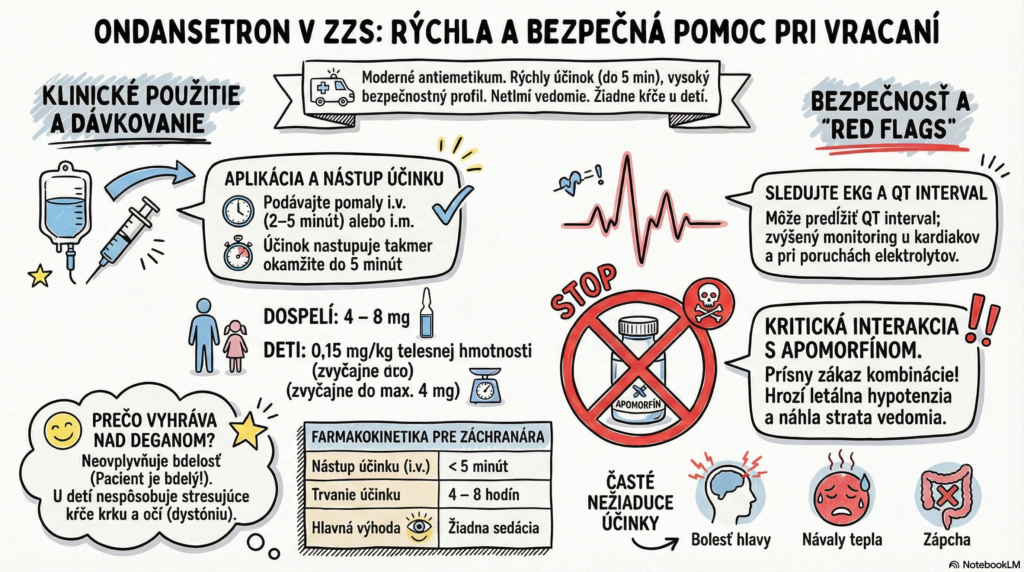

Introduction Ondansetron is a highly selective serotonin 5-HT3 receptor antagonist. In emergency medicine it represents a modern, safe alternative to older antiemetics (metoclopramide, thiethylperazine), particularly due to the absence of extrapyramidal side effects and high efficacy against severe vomiting.
1. Drug Identification
- Active substance: Ondansetronum (as ondansetron hydrochloride dihydrate).
- Trade names in Slovakia: Ondansetron Accord, Zofran, Emeset.
- ATC classification: A04AA01 (Serotonin 5-HT3 antagonists).
- Dosage form in EMS: Injection solution 4 mg/2 ml or 8 mg/4 ml (ampule).
- Pharmacological group: Antiemetic.
2. Mechanism of Action (Pharmacodynamics) Ondansetron blocks type 3 serotonin receptors at two key levels:
- Peripheral effect: Blockade of 5-HT3 receptors on vagal afferent endings in the GI tract. Serotonin released from the small-intestine mucosa (e.g., due to irritation or ischemia) can no longer stimulate the vagal vomiting reflex.
- Central effect: Blockade of 5-HT3 receptors in the area postrema (chemoreceptor trigger zone) in the medulla.
- Result: Strong suppression of nausea and vomiting without affecting dopamine receptors, eliminating the risk of facial muscle spasms.
3. Hemodynamic Effects – IN DETAIL
- BP and HR: The drug has no direct effect on blood pressure or heart rate at standard doses.
- Cardiac interval: A significant risk is QT prolongation. Ondansetron can affect myocardial repolarization, increasing the risk of the malignant arrhythmia Torsades de Pointes (TdP).
- Safety: Extra caution is needed in patients with electrolyte imbalances (hypokalemia, hypomagnesemia), which is common in vomiting patients.
4. Pharmacokinetics (from a Paramedic’s Perspective)
- Routes of administration: IV (slow injection), IM, and in hospital also PO (dispersible tablets).
- Onset of action: Very fast with IV administration (within 5–10 minutes).
- Duration of effect: 4–8 hours.
- Metabolism: Extensive hepatic metabolism (CYP450 enzymes).
5. Indications in Prehospital Practice
- Symptomatic treatment of persistent vomiting: Particularly in acute gastroenteritis, where rapid dehydration is a risk (excellent profile in children).
- Oncology conditions: Nausea from cytotoxic chemotherapy or radiotherapy during transport.
- First-line treatment failure: If metoclopramide or thiethylperazine fails to suppress symptoms.
6. Dosing in EMS
- Adult: 4 mg to 8 mg IV (slow administration over 2–5 minutes).
- Pediatrics: 0.15 mg/kg body weight IV (usual dose up to a maximum of 4 mg).
- Scope of practice: Physician (RLP). A basic-crew paramedic (RZP) — in Slovakia, ondansetron is increasingly included in standard treatment protocols for crews without a physician, due to its safety.
7. Contraindications
- Absolute: Hypersensitivity to ondansetron or other 5-HT3 antagonists, concurrent administration with apomorphine (cases of severe hypotension and loss of consciousness have been reported).
- Relative: Congenital long QT syndrome, congestive heart failure, bradyarrhythmias.
8. Adverse Effects
- Common: Headache (frequently reported by patients after administration), a sensation of warmth or flushing, constipation.
- Serious: QT prolongation, transient visual disturbances (with rapid IV administration).
9. Drug Interactions in EMS
- Apomorphine: Strictly contraindicated combination.
- QT-prolonging agents: (e.g., amiodarone, sotalol, certain neuroleptics) — ECG monitoring is required.
- Serotonergic agents (SSRIs, SNRIs): Risk of serotonin syndrome (confusion, tachycardia, hyperreflexia).
10. Specifics in Emergency Medicine
- Error #1: Too-rapid administration. Can trigger sudden headache, dizziness, and visual disturbances. Always administer over at least 2 minutes.
- Error #2: Underestimating electrolytes. If the patient has been vomiting for a long time and has low potassium, arrhythmia risk after ondansetron rises.
- Pediatric advantage: Unlike Degan, it does not cause dystonic reactions (spasmodic movements) in children, which is a huge advantage in the field for patient stability.
Professional Literature and Sources
- Dobiáš, V. et al. (2021): Emergency Healthcare. 3rd edition. Martin: Osveta.
- SmPC (Summary of Product Characteristics) – Ondansetron Accord 2 mg/ml. Slovak State Institute for Drug Control (ŠÚKL).
- Šuleková, M., et al. (2023): Pharmacology for Paramedics. Bratislava: Herba.
- Lüllmann, H., Mohr, K., Hein, L. (2014): Pharmacology and Toxicology. 2nd Czech edition. Prague: Grada.
- EMA Pharmacovigilance Risk Assessment Committee (2019): Updated recommendations on the use of ondansetron during pregnancy and warnings regarding QT prolongation.
- Remedium (2025): Current Approaches in Emergency Pharmacotherapy. Professional emergency medicine periodical.