Vehicle Breakdown During a Call —
procedure and protocol for the EMS driver
An ambulance breakdown during a call threatens the patient, the crew, and traffic safety all at once. The driver must decide within seconds — stop, report, secure the scene, and coordinate next steps with dispatch.
No daily technical inspection guarantees a vehicle won’t fail during a call. Tire, engine, brakes, electrical system — every failure has a different nature, different risk, and a different procedure. A driver who knows how to respond minimizes the time until a replacement crew reaches the patient.
First principle: dispatch is the first person you inform
Regardless of the type of failure — Slovak Act No. 579/2004 Coll. on Emergency Medical Services obligates the operations center to manage, coordinate, and evaluate EMS activity so as to ensure its continuity and uninterrupted operation (§ 6(3)(a)). Dispatch cannot coordinate what it doesn’t know about. Every failure affecting the ability to continue the call must be reported immediately.
The EMS operations center is obligated to manage, coordinate, and evaluate the activity of the emergency medical service so as to ensure its continuity and uninterrupted operation.
Source: § 6(3)(a) of Act No. 579/2004 Coll. on Emergency Medical ServicesFor the driver, this has a concrete practical consequence: dispatch can send a replacement vehicle, inform the destination facility of a delay, coordinate with police or firefighters — but only if it receives the information immediately, not after the crew has tried to solve the problem on their own.
Classifying failures by severity
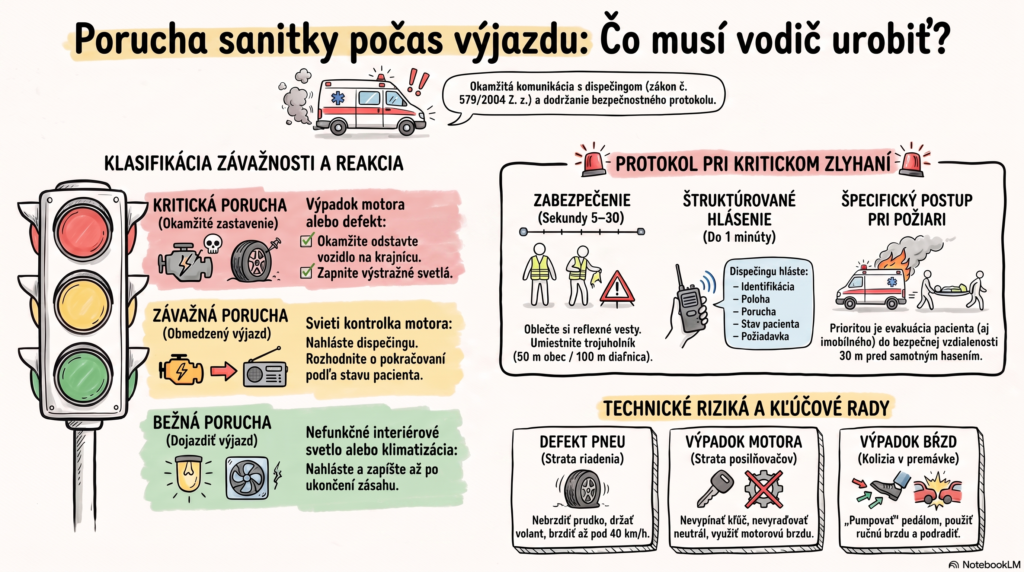
Not every failure is the same. In terms of subsequent procedure, we distinguish three categories:
| Category | Examples | Immediate impact | Procedure |
|---|---|---|---|
| Critical Stops the call | Engine failure, a tire blowout while driving, brake failure, a vehicle fire, a collision | The vehicle cannot continue. Immediate danger to the crew and patient. | Immediate stop in a safe location, securing the crew and patient, reporting to dispatch, calling for help. |
| Serious Limits the call | An engine warning light, a lighting or siren failure, a patient compartment A/C fault, low oil pressure | The vehicle may continue at reduced speed or for a short distance. Risk of escalation. | Immediate report to dispatch, decision on continuing or stopping based on dispatch instructions and the patient’s condition. |
| Minor Does not limit the call | A non-functional interior bulb, a minor electronic fault, a driver’s cab A/C outage | The call continues without limitation. | Record it, report it after the call ends, log it in the defect book. |
Protocol for a critical failure — step by step
Get the vehicle out of the traffic lane onto the shoulder, a rest area, or a parking lot as quickly as possible. Don’t stop in a tunnel, on a bridge, in a curve, or in the middle of an intersection — as far as the situation allows. Turn on the hazard lights.
Place the warning triangle behind the vehicle — at least 50 m on an ordinary road, 100 m on a motorway. The crew puts on reflective vests before exiting the vehicle. If there’s a patient on board, the paramedic immediately treats them and assesses their condition.
The driver or paramedic contacts dispatch. The message must include: vehicle identification (license plate / station number), location (GPS or landmark), type of failure, condition of the patient on board (if any), and the request for next steps.
Dispatch decides on sending a replacement vehicle, or possibly calling a tow service, police, or fire brigade. The EMS crew stays with the patient and continues urgent healthcare until the replacement vehicle or ambulance arrives.
An entry in the call log describing the failure, location, times, and subsequent procedure. Reporting to the shift supervisor. An entry in the vehicle defect log. If the failure was caused by a defect that should have been caught by the daily inspection — root-cause analysis.
“[Identification] — [Location] — [Failure] — [Patient condition] — [Request]”
Example: “RZP Nitra 3, we’re stopped on the D1 at km 87 heading toward Bratislava, engine failure, no patient on board, requesting a replacement vehicle and a tow.”
Example with a patient: “RLP Nitra 1, we’re stopped on Štefánik Street near the Tesco, front tire blowout, patient on board, condition stable, requesting a replacement vehicle to take over the patient.”
Specific situations — how to respond
A tire blowout while driving
The most common critical failure. A front tire is more dangerous than a rear one — it can cause immediate loss of steering. Procedure: hold the steering wheel firmly, don’t brake hard, let the vehicle slow down, steer toward the right shoulder. Hard braking during a front-tire blowout can flip the vehicle.
For a tire blowout during priority driving at high speed, the rule is: don’t brake hard, don’t let go of the wheel, steer toward the right shoulder. Only once you’ve slowed below 40 km/h can you gently brake and stop. Attempts to stop abruptly or jerk the wheel are the leading cause of vehicle rollover during a blowout.
Engine failure during a call
The engine fails — power steering and the brake booster stop working. Steering becomes much heavier, braking distance lengthens significantly. Procedure: don’t shift into neutral or turn off the ignition key — stay in gear, use engine braking, steer toward the right shoulder. If possible, let the vehicle coast to a safe location.
Vehicle fire
The most critical situation — stop immediately, turn off the engine, evacuate the crew and the patient to a safe distance (min. 30 m from the vehicle). Only then the fire extinguisher — and only if the fire is small and the driver isn’t endangered. Crew and patient safety is the priority, not saving the vehicle.
The patient must be evacuated before firefighting begins. If the patient is immobile, the paramedic and driver carry them out manually — regardless of spinal injuries or other transport contraindications. The risk of fire outweighs the risk of secondary injury during evacuation.
Brake failure
If the brake pedal “falls to the floor” — use pump braking, the parking brake, engine braking (downshift). Look for a safe way out of traffic. Never turn off the ignition key while driving — you’ll lose power steering and the steering wheel lock. Use the horn and hazard lights to warn other road users.
A situation with a patient on board — crew priorities
A vehicle failure with a patient on board is fundamentally different from a failure with an empty vehicle. The paramedic immediately focuses on the patient — the driver handles the vehicle, the scene, and communication with dispatch.
Driver: safely stopping the vehicle, warning triangle, vests, reporting to dispatch, contact with the tow service/police, documentation.
Paramedic (RZP) / paramedic + physician (RLP): continuous urgent healthcare for the patient, monitoring vital signs, preparation for handover to a replacement crew.
These tasks are parallel — the driver doesn’t handle the patient, the paramedic doesn’t handle the vehicle. Communication happens over the radio, not through open doors.
Three scenarios from practice
An RZP is rushing to a priority-1 call on the D1. The rear left tire blows — the vehicle starts pulling left.
An RLP is transporting a post-STEMI patient to the catheterization lab. The engine warning light comes on the dashboard. The patient is hemodynamically stable.
After arriving at the scene, the paramedic notices smoke from the engine compartment. The crew is currently triaging the patient beside the vehicle.
- VZ-TECH-01 — Daily Technical Vehicle Inspection for EMS/ALS Units
- VZ-TECH-02 — Vehicle Breakdown During a Call — Procedure and Protocol (this article)
- VZ-TECH-03 — Communicating with Dispatch During a Vehicle Outage
- Slovak Act No. 579/2004 Coll. on Emergency Medical Services, § 6(3)(a) — duty of the operations center to manage and coordinate EMS activity so as to ensure its continuity and uninterrupted operation.
- Slovak Act No. 8/2009 Coll. on Road Traffic, § 26 — duties during emergency stopping; § 31 — warning triangle and securing the scene.
- Decree of the Slovak Ministry of Health No. 10548/2009-OL — minimum material-technical equipment of EMS ambulances, including fire extinguisher and warning triangle.
- Slovak Act No. 579/2004 Coll., § 10 — paramedic duties, including the duty to provide urgent healthcare.
- National EMS Management Association (NEMSMA). EMS Vehicle Breakdown and Out-of-Service Protocols. 2022. nemsma.org
- Bledsoe BE, Porter RS, Cherry RA. Paramedic Care: Principles and Practice. 5th ed. Pearson, 2017. Chapter: EMS Vehicle Operations and Safety.
- National Fire Protection Association (NFPA) 1917 — Standard for Automotive Ambulances. 2019 edition. (reference for fire safety of EMS vehicles)