In emergency medicine, we often talk about the “golden hour” or the “platinum ten minutes.” But from the standpoint of command and control, there is an even more critical time window: the first 60 seconds. This minute represents the transition from the relatively controlled environment of the ambulance to the unpredictable dynamics of the scene. It is the moment that defines the trajectory of the patient’s outcome and the safety of the crew. If a paramedic loses control of the first minute, the rest of the call is spent in reactive mode, where the event drives them, instead of the other way around.
1. Introduction: situational awareness as the cornerstone
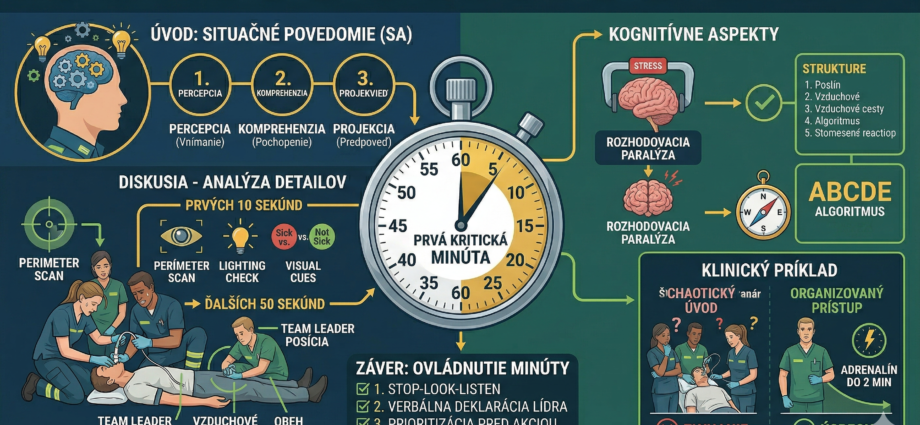
The first minute is about building situational awareness (SA). SA is not simply “noticing things” — it is a complex process of perceiving elements in the environment, understanding their meaning, and projecting their state into the near future.
In EMS, we break SA down into three levels:
- Perception: I see what’s happening (e.g., the patient is lying in an unnatural position, there’s an empty pill bottle on the floor).
- Comprehension: I understand what it means (the combination of position and medication suggests intoxication and an aspiration risk).
- Projection: I predict how it will develop (if I don’t secure the airway immediately, the patient will go apneic and into cardiac arrest within 3 minutes).
An excellent paramedic uses the first minute to calibrate this mental model before ever touching the patient.
2. Discussion and detailed analysis: the anatomy of 60 seconds
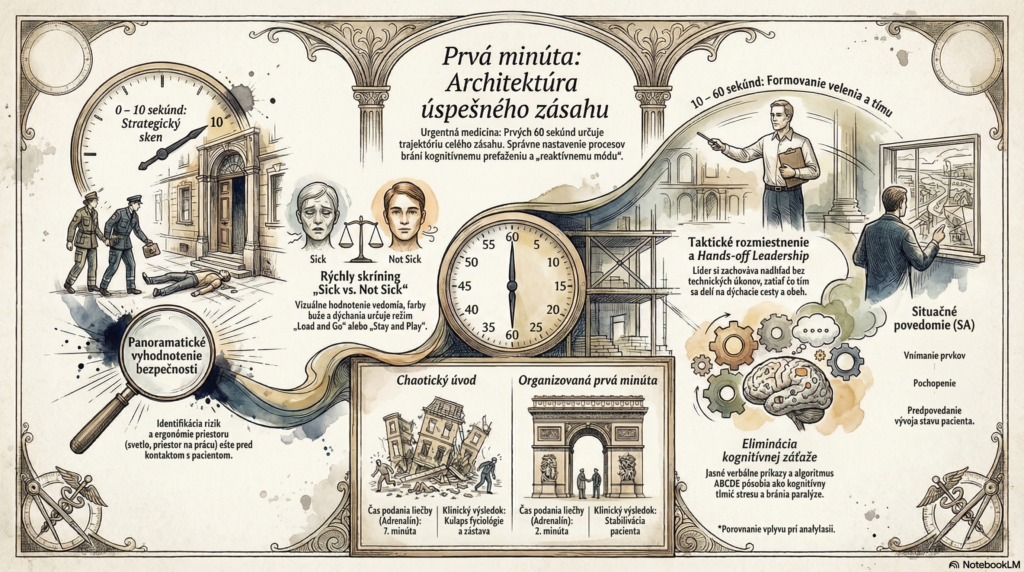
The first 10 seconds: strategic scan and safety
The difference between an average and an excellent paramedic begins even before exiting the vehicle and peaks in the first ten seconds on scene. While a novice runs toward the patient fixated on the “main problem,” the experienced professional performs a panoramic scan.
- Scene safety: It’s not just about aggressive dogs or a gas leak. It’s about ergonomics. Is there enough light in the room? Is there space to work all the way around the patient?
- Visual triage: Even from the doorway, an excellent paramedic assesses “sick vs. not sick.” They see use of accessory breathing muscles, skin color, and level of consciousness. These 10 seconds determine whether the call proceeds in “load and go” or “stay and play” mode.
The remaining 50 seconds: working diagnosis and setting the tone
After the initial scan comes the contact phase. This is where the working diagnosis forms and the clinical priority is set.
- Positioning micro-decisions: Where does the team leader stand? Where is the paramedic responsible for the airway? An excellent team positions itself strategically. If the patient is unconscious, the “airway person” is automatically at the head, the “circulation person” is at the side, and the team leader takes a position with a clear view of both the whole team and the monitor (the so-called “10 o’clock position”).
- Task division: This phase must not waste time with questions like “who’s taking the blood pressure?” Clear commands in the first minute (e.g., “Peter, power up the monitor and attach the electrodes, I’ve got the airway”) eliminate cognitive load for the whole team.
These seemingly trivial details directly affect the time to definitive treatment. A poorly positioned team at the outset means having to reposition patients or equipment later, which in critical conditions (e.g., STEMI or massive hemorrhage) delays key interventions by precious minutes.
3. Cognitive aspects: fighting decision paralysis
A high-stress environment activates the amygdala, which can lead to analysis paralysis. The paramedic is flooded with information (noise, family emotions, the patient’s critical condition), and their working memory collapses.
The remedy is strict structure in the first minute. Using algorithms like ABCDE is not just a clinical aid — it’s a cognitive stress dampener. If the paramedic sticks to the structure, their brain doesn’t need to invent “what’s next” every second; it just fills in predefined boxes. Excellent teams use the first minute to “slow down in order to speed up.” By deliberately slowing their movements and lowering their vocal tempo, they transmit calm to the rest of the team and the patient, preventing cognitive overload.
4. Clinical example: chaos vs. organization
Scenario: anaphylactic shock in a 4th-floor apartment.
- Chaotic start: The crew runs into the apartment, both paramedics crouch over the patient. One starts taking a blood pressure, the other asks the family about allergies. No one addresses the airway, which is closing. The room is cramped, the monitor is behind the paramedic’s back. Result: epinephrine isn’t given until minute 7, because it had to be dug out of a poorly accessible bag and the crew couldn’t agree on the dose. The patient’s physiology collapses into arrest.
- Organized approach (first minute): The team leader pauses the team at the entrance (10 s). Identifies stridor and facial swelling. Orders: “Jana, prepare epinephrine 0.5 mg IM right away, I’ll handle oxygen and positioning.” (20 s). The team moves a table aside to create working space (30 s). While the medication is being drawn up, the leader briefly informs the family and asks for the insurance card (60 s). Result: epinephrine given in minute 2. The patient’s physiology stabilizes before total airway obstruction occurs.
The difference in survival here is directly proportional to the micro-decisions made in the opening 60 seconds.
5. Conclusion: how to master the first minute
Mastering the first minute is not a talent — it’s a trainable skill. For EMS teams, I recommend the following practices:
- Stop-look-listen: Take a deliberate 2-second pause before approaching the patient. Identify hazards and the ergonomics of the space.
- Verbal declaration by the leader: “I’m taking command, we’re running this as a critical patient.” This clearly sets the hierarchy and expectations.
- Prioritize before acting: Always address the biggest threat (e.g., massive hemorrhage) before getting distracted assessing less important parameters.
- Hands-off leadership: In the first minute, the leader should perform as few technical tasks as possible, in order to preserve maximum situational awareness.
The first minute is your “operating system.” If it boots correctly, every subsequent application (intervention) will run smoothly. If it boots with an error, the entire system (the call) will sooner or later fail.
Sources and recommended reading:
- Endsley, M. R. (1995): Toward a theory of situation awareness in dynamic systems. Human Factors Journal.
- Brindley, P. G., & Fanning, R. M. (2013): Crew Resource Management and Teamwork. In: Patient Safety in Anaesthesia.
- Slovak EMS Methodological Sheets: Standard operating procedures for first-response crews.
- Lauber, J. K. (1984): Resource management in the cockpit. Air Line Pilot. (Foundations of CRM applicable to medicine.)