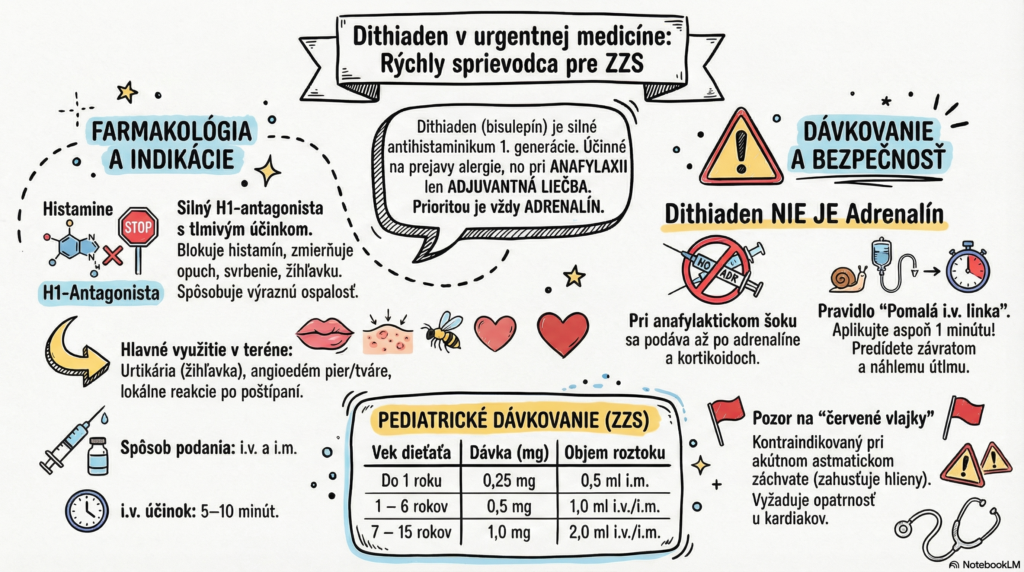
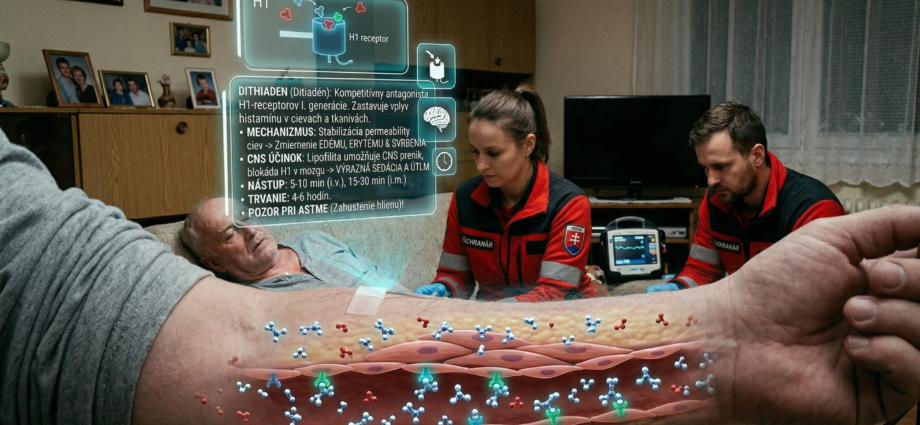
Introduction Dithiaden (bisulepine) is a potent first-generation antihistamine with strong antiallergic and sedative effects. In emergency medicine it’s used to block H1 receptors, easing manifestations of allergy such as itching, mucosal swelling, urticaria (hives), and histamine-induced bronchospasm.
1. Drug Identification
- Active substance: Bisulepini hydrochloridum.
- Trade name in Slovakia: Dithiaden.
- ATC classification: R06AX (Other antihistamines for systemic use).
- Dosage form in EMS: Injection solution 1 mg/2 ml (ampule).
- Pharmacological group: Antihistamine (H1 antagonist).
2. Mechanism of Action (Pharmacodynamics) Dithiaden acts as a competitive antagonist at histamine H1 receptors:
- Peripheral effect: Blocks histamine’s effects on vascular smooth muscle (reduces permeability — suppresses swelling) and bronchi (reduces bronchoconstriction). Eases itching and skin redness.
- Central effect: Crosses the blood-brain barrier, where it blocks H1 receptors in the CNS, leading to marked sedation (drowsiness).
- Anticholinergic effect: Has mild atropine-like effects (dry mouth, mild tachycardia).
3. Hemodynamic Effects – IN DETAIL
- BP and HR: Hemodynamics are stable with standard IV administration. In anaphylaxis, it helps indirectly stabilize BP by preventing further fluid leakage from vessels into tissue (edema).
- Risk: With very rapid IV administration in the elderly or cardiac patients, transient tachycardia can occur.
4. Pharmacokinetics (from a Paramedic’s Perspective)
- Routes of administration: IV (slowly!), IM.
- Onset of action: With IV administration, nearly immediate (within 5–10 minutes).
- Duration of effect: 4–6 hours.
- Metabolism: Hepatic. Elimination: renal.
5. Main Indications in EMS
- Type 1 allergic reactions: Urticaria, angioedema (lip, face, throat swelling), allergic rhinitis.
- Anaphylactic shock (adjunctive treatment): Dithiaden is given ONLY AFTER epinephrine and corticosteroids, to block receptors and prevent relapse of symptoms.
- Insect stings: With local or systemic reactions.
- Premedication: Before administering substances that release histamine (e.g., certain contrast agents — less common in RZP practice).
6. Dosing in EMS
- Adult: 1 mg to 2 mg (1–2 ampules) IV or IM.
- Pediatrics:
- Children under 1 year: 0.25 mg IM (0.5 ml solution).
- Children 1–6 years: 0.5 mg IV/IM (1 ml solution).
- Children 7–15 years: 1 mg IV/IM (2 ml solution).
- Scope of practice: Basic-crew paramedic (RZP) and physician (RLP) both.
7. Contraindications
- Absolute: Hypersensitivity to bisulepine, conditions requiring full alertness (relative in EMS), children under 2 months (except for vital indications).
- Relative: Angle-closure glaucoma, prostatic hypertrophy (urinary retention risk due to anticholinergic effect), acute asthma attack (can thicken bronchial secretions).
8. Adverse Effects
- Drowsiness and sedation: Very common. The patient must not drive after administration.
- Anticholinergic manifestations: Dry mouth, ocular accommodation disturbances, possible confusion in the elderly.
- Paradoxical excitation: In children, restlessness instead of sedation can sometimes occur after administration.
9. Drug Interactions in EMS
- Alcohol and sedatives: Significantly potentiate CNS and respiratory depression.
- Analgesics: Potentiates the effect of opioids.
10. Specifics in Emergency Medicine
- Error #1: Dithiaden as the first drug in anaphylaxis. A common and dangerous mistake. EPINEPHRINE is drug #1. Dithiaden doesn’t save a life in shock immediately — it only blocks receptors for future histamine molecules.
- Error #2: A rapid IV bolus. Administer slowly, over at least 1 minute, to minimize dizziness and sudden drowsiness risk.
- Error #3: Administration in asthma. With severe bronchoconstriction, Dithiaden can thicken secretions, making expectoration harder.
11. Red Flags
- Hypotension after administration: If the patient “fades” after IV administration, check BP (it could indicate deepening anaphylaxis or a drug reaction).
- Stridor: If laryngeal swelling doesn’t improve after Dithiaden, immediate epinephrine inhalation or intubation is needed.
12. Practical Field Scenario Situation: A 25-year-old woman after eating peanuts, complaining of full-body itching and lip swelling. Breathing is clear, BP 120/80. Status: Generalized urticaria, stable vital signs. Decision-making:
- Monitor vital signs, secure IV access.
- Dithiaden 2 mg (2 ampules) IV, slowly.
- Give a corticosteroid (e.g., methylprednisolone 125 mg IV).
- Watch for progression to anaphylaxis (have epinephrine IM ready).
13. Practical Summary – 5 Key Points
- Dithiaden is not epinephrine: In anaphylaxis it’s only an adjunctive drug.
- Sedation is the rule: Expect the patient to be drowsy after administration.
- IV slowly: Prevention of systemic reactions.
- Watch for prostate and glaucoma patients: Can worsen their condition.
- Excellent for itching: The fastest relief for acute hives.
Professional Literature and Sources
- Dobiáš, V. et al. (2021): Emergency Healthcare. Osveta.
- Šuleková, M. (2023): Pharmacology for Paramedics. Herba.
- SmPC (Summary of Product Characteristics) – Dithiaden. ŠÚKL.
- ERC Guidelines 2021: Anaphylaxis section.