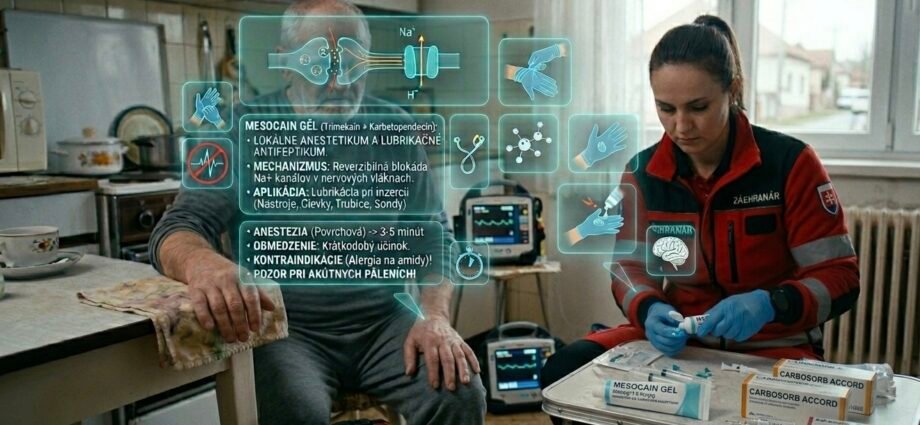
Introduction Mesocain gel (trimecaine) is an amide-type local anesthetic with a fast onset of action. In emergency medicine it’s used mainly to reduce pain and reflex response during insertion of devices into body orifices (catheterization, intubation) and for surface anesthesia of mucous membranes.
1. Drug Identification
- Active substance: Trimecaini hydrochloridum.
- Trade name in Slovakia: Mesocain gel.
- ATC classification: N01BB04 (Local anesthetics, amides).
- Dosage form in EMS: Gel, 20 g (1% trimecaine).
- Pharmacology: Surface local anesthetic.
2. Mechanism of Action (Pharmacodynamics)
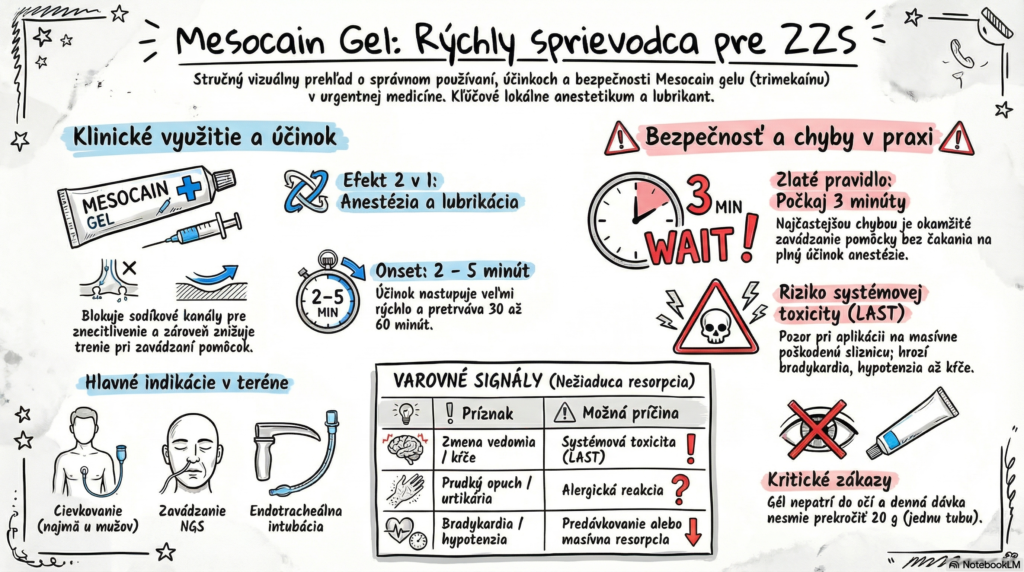
- Sodium channel blockade: Trimecaine binds to sodium channel receptors in nerve fiber membranes. This prevents sodium ions from entering the cell, blocking generation and propagation of the action potential (the pain signal).
- Selectivity: First blocks pain perception, then temperature, cold, and pressure sensation.
- Lubricating effect: Besides anesthesia, the gel acts as a mechanical lubricant, reducing friction and mucosal trauma risk.
3. Hemodynamic Effects – IN DETAIL
- Local: Causes mild vasodilation at the application site.
- Systemic: With standard topical application, systemic effects (on BP and HR) are negligible.
- Absorption risk: If the gel is applied to extensive burns or massively damaged mucosa, systemic absorption is a risk, where it can act as an antiarrhythmic (similar to lidocaine) or, on overdose, cause bradycardia and hypotension.
4. Pharmacokinetics (from a Paramedic’s Perspective)
- Route of administration: Topical (on mucous membranes, urethra, insertion devices).
- Onset of action: Very fast, usually 2–5 minutes.
- Duration of effect: 30–60 minutes.
- Metabolism: Hepatic.
5. Main Indications in EMS
- Bladder catheterization: Most common use in immobile or retention patients (particularly for urethral anesthesia in men).
- Nasogastric tube (NGT) insertion: Reducing the gag reflex and nasopharyngeal pain.
- Endotracheal intubation: Lubrication and anesthesia of the tube’s distal end (reduces laryngospasm risk under light anesthesia).
- Surface mucosal trauma: E.g., painful mouth ulcers or minor rectal injuries.
6. Dosing in EMS
- Adult: The amount of gel depends on the procedure. For urethral catheterization in men, approximately 5–10 ml is applied directly into the urethral meatus.
- Maximum dose: Do not exceed 20 g of gel (1 full tube) in an adult per 24 hours, due to systemic toxicity risk.
- Scope of practice: Basic-crew paramedic (RZP) and physician (RLP) both.
7. Contraindications
- Absolute: Hypersensitivity to trimecaine or other amide-type local anesthetics.
- Relative: Severe cardiac rhythm disturbances (AV blocks), acute heart failure (in the case of expected massive resorption).
8. Adverse Effects
- Local: Mild burning right after application, which quickly resolves as anesthesia takes effect.
- Allergic: Urticaria, in extreme cases anaphylactic shock.
- Systemic (with toxicity): Consciousness disturbances, seizures, bradycardia, hypotension.
9. Drug Interactions in EMS
- Antiarrhythmics: With systemic absorption, additive effect with drugs like amiodarone is possible.
10. Specifics in Emergency Medicine
- Error #1: Not waiting long enough. The paramedic applies the gel and immediately inserts the catheter. The patient feels pain. Wait at least 2–3 minutes for full effect.
- Error #2: Application to the eyes. Mesocain gel does not belong in the eye! For ocular use, a specialized product or local anesthetics designed for ophthalmology are used instead.
- Error #3: Contamination. If you use the tube multiple times (across different patients), cross-infection is a risk. Ideally use sterile single-use packages or maintain strict sterility of the tube opening.
11. Red Flags
- Change in consciousness/seizures: If these appear shortly after application to damaged mucosa, suspect local anesthetic systemic toxicity (LAST).
- Sudden swelling: An allergic reaction to a gel component.
12. Practical Summary – 5 Key Points
- Wait 3 minutes: Give trimecaine time to work.
- Lubricant + anesthetic: Addresses both pain and mechanical resistance.
- Watch damaged mucosa: Increases absorption into the bloodstream.
- Male urethra: A key step before catheterization to prevent trauma.
- Not for the eyes: Use only on mucous membranes and skin.
Professional Literature and Sources
- Dobiáš, V. et al. (2021): Emergency Healthcare. Osveta.
- Šuleková, M. (2023): Pharmacology for Paramedics. Herba.
- SmPC – Mesocain gel. Slovak State Institute for Drug Control (ŠÚKL).
- Lüllmann, H. (2014): Pharmacology and Toxicology. Grada.