Parking at the Scene of a Call —
tactical positioning of the vehicle
Where and how the driver positions the ambulance determines crew safety, access to the patient, and how quickly they can leave. Tactical vehicle positioning is a skill — not an accident.
An EMS driver isn’t just someone who brought the crew to the scene. The vehicle’s position is the first tactical decision of the entire call — it affects the crew’s protection from traffic, access to the patient with the stretcher, lighting of the scene, and the escape route. A bad position is hard to fix once the call is underway.
Four goals of tactical positioning
1. Protection of the crew and patient — the vehicle as a physical barrier between traffic and the work site.
2. Access to the patient — rear doors facing the patient, room for the stretcher, level ground.
3. An escape route — the vehicle must not be blocked; leaving with the patient must be possible without reversing through a crowd or turning in a tight space.
4. Visibility and lighting — warning lights visible to approaching traffic; at night, lighting for the scene.
The fend-off position — the basis of protection on the road
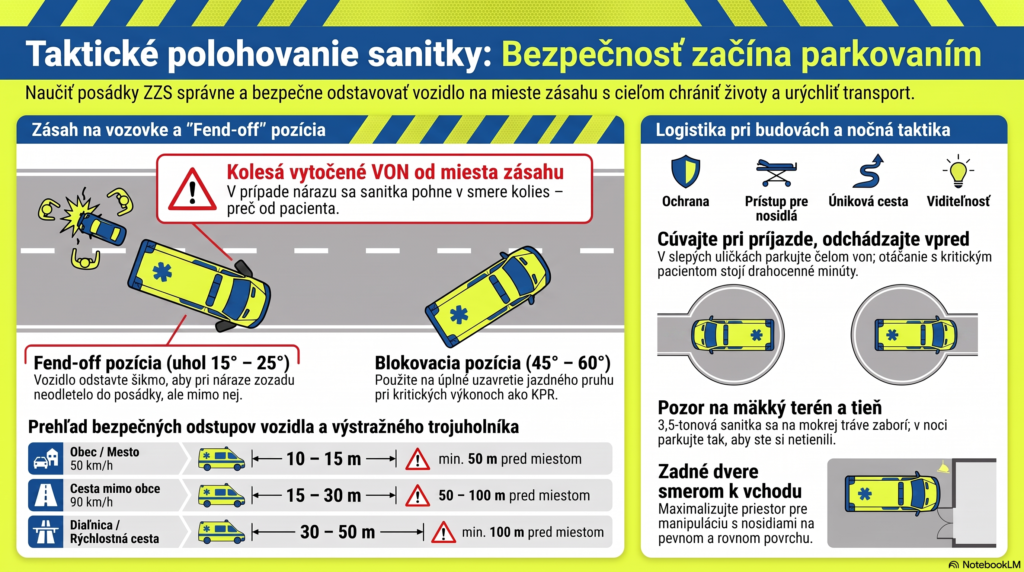
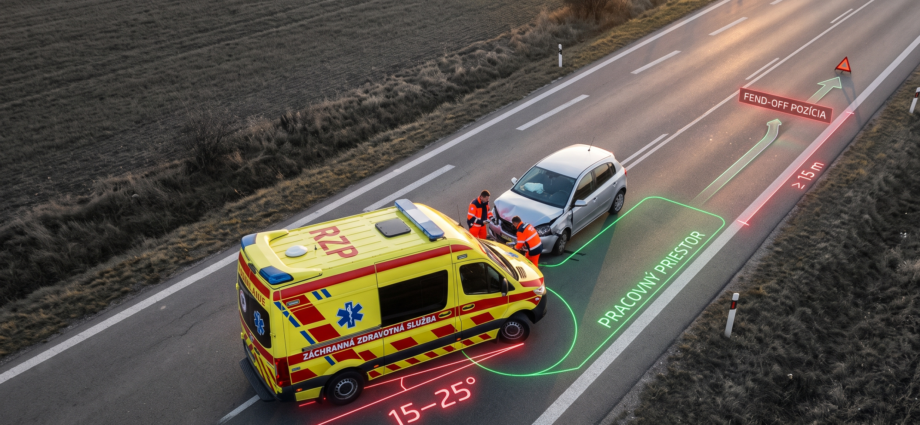
When working on the roadway or shoulder (a traffic accident, a patient on the road), the EMS vehicle is positioned in what’s called a fend-off position — angled, with the wheels turned away from the scene. Goal: if another vehicle strikes the ambulance, the impact deflects it away from the crew’s work area, not into it.
If another vehicle strikes a stationary ambulance, the ambulance moves in the direction the front wheels are turned. Wheels turned toward the scene = the ambulance drives into the crew and patient. Wheels turned away from the scene = the ambulance deflects into open space. This detail — turning the wheel after stopping — takes two seconds and can decide the crew’s life.
The blocking position — when a lane must be closed
When working directly on the roadway (CPR on the road, extrication), it may be necessary to block the entire traffic lane — the ambulance is positioned across the lane in front of the scene, physically preventing traffic from entering the work zone. The blocking position is typically established by the first vehicle on scene; once fire or police arrive, their apparatus takes over blocking and the ambulance can reposition closer to the patient.
Safe distances by road type
| Road type | Vehicle standoff from the scene | Warning triangle placement |
|---|---|---|
| Town / city (up to 50 km/h) | 10 – 15 m | min. 50 m before the scene |
| Rural road (90 km/h) | 15 – 30 m | min. 50 m, ideally 100 m |
| Motorway / expressway | 30 – 50 m | min. 100 m before the scene |
| A blind section (curve, hill) | Increase the standoff — the vehicle must be visible before the curve/hill | before the curve / crest of the hill |
The driver of a vehicle with the right of priority driving may stop and park at a location where this is otherwise prohibited, if necessary to carry out their duties — provided they do not endanger road safety. The vehicle’s position at the scene of a call is therefore legally covered — but the tactical correctness of the position is up to the driver.
Source: Act No. 8/2009 Coll. on Road Traffic — entitlements of vehicles with the right of priority drivingPositioning off the roadway — apartment buildings, houses, complexes
Most calls don’t end on the road, but at an apartment building, a house, or an enclosed complex. Tactics apply here too — different, but equally important.
Rear doors to the entrance. The stretcher comes out through the rear doors — position the vehicle so the distance between the stretcher and the entrance is as short as possible and without stairs, curbs, or lawns, if they can be avoided.
Never block your own way out. In a dead-end street or courtyard, park nose-out. Turning around with a critically ill patient costs minutes. Reversing in on arrival = driving straight out on departure.
Leave room for the physician response vehicle / air ambulance. If you’re expecting a physician to arrive (a meet-up system) or a helicopter, leave them space — the physician response vehicle needs access to your rear doors.
Watch out for soft ground. A lawn after rain, snow, mud — a 3.5-tonne vehicle will get stuck. Better to park 20 meters further away on solid ground than have a bogged-down ambulance five meters from the entrance.
Parking brake + gear. Always. Even on level ground. On a slope, turn the wheels toward the curb.
A nighttime call — the vehicle as a light source
At night, the EMS vehicle is the strongest light source at the scene. The vehicle’s position determines whether the crew works in light or in their own shadow.
Headlights on the work site — if the position allows, aim the headlights at the patient/work area.
Watch for blinding others — high beams toward approaching traffic blind drivers, who then can’t see the crew on the road. On the roadway, light the work site, not oncoming traffic.
Warning lights kept on — the blue lights run throughout the entire call, even off the roadway. They mark the location for additional crews and other emergency services.
Shadow is the enemy — check that the vehicle isn’t casting a shadow exactly where the paramedic is working with the patient.
Three scenarios from practice
An RZP arrives as the first emergency service at a two-car accident on a rural road. Neither police nor firefighters are on scene yet.
A call for unconsciousness on the 4th floor of an apartment building. Cars are parked in front of the entrance; an open spot is 40 m away or on the lawn right by the entrance.
A call for a patient with chest pain at a house at the end of a dead-end street 4 meters wide.
- VZ-TAK-01 — Defensive Driving vs. Emergency Driving — Where Is the Line?
- VZ-TAK-02 — Parking at the Scene of a Call — Tactical Vehicle Positioning (this article)
- VZ-TAK-03 — Night Driving with the Crew — Specifics and Risks
- VZ-TAK-04 — Driving in Adverse Weather Conditions
- VZ-TAK-05 — Passing Through Tunnels, Bridges, and Narrow Streets
- Slovak Act No. 8/2009 Coll. on Road Traffic — entitlements of vehicles with the right of priority driving when stopping and parking; § 23, § 24 — stopping and parking.
- Slovak Act No. 8/2009 Coll., § 26 — emergency stopping and related duties, including the warning triangle.
- USFA / FEMA. Traffic Incident Management Systems (TIMS) — Emergency Vehicle Positioning. U.S. Fire Administration, 2020.
- NFPA 1500 — Standard on Fire Department Occupational Safety, Health, and Wellness Program — chapter on roadway work (blocking positions).
- Responder Safety Institute. Blocking Procedures and Apparatus Placement at Roadway Incidents. respondersafety.com, 2023.
- Maguire BJ, Hunting KL, Smith GS, Levick NR. Occupational fatalities in emergency medical services: A hidden crisis. Annals of Emergency Medicine. 2002;40(6):625–632.