Defensive Driving vs. Emergency Driving —
Where Is the Line?
Every EMS driver knows both terms. Few know precisely where one ends and the other begins — and why this boundary matters not just tactically, but legally too.
Emergency driving isn’t the opposite of defensive driving — it’s built on top of it. An EMS driver who doesn’t understand this either drives too slowly and the patient waits, or too fast and endangers the crew and other road users. The correct driving tactic always lies somewhere between these two extremes.
What defensive driving is
Defensive driving is a style of vehicle operation in which the driver actively anticipates danger before it occurs. It isn’t driving slowly — it’s driving with maximum situational awareness, an adequate reaction reserve, and the assumption that other road users may behave unpredictably.
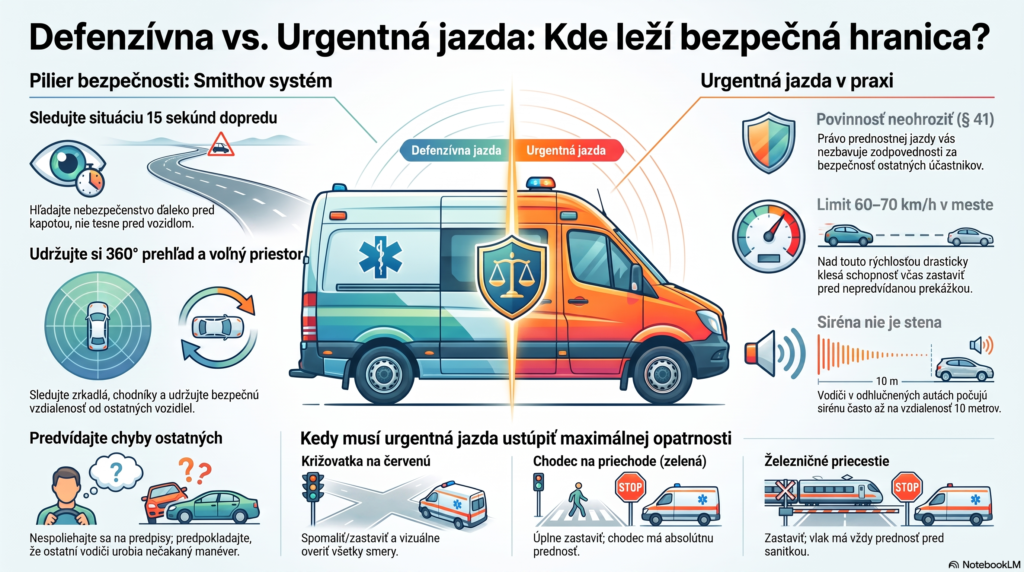
Defensive driving rests on five principles that the American National Safety Council (NSC) defines as the Smith System — and which apply equally to a passenger-car driver and to an ambulance driver:
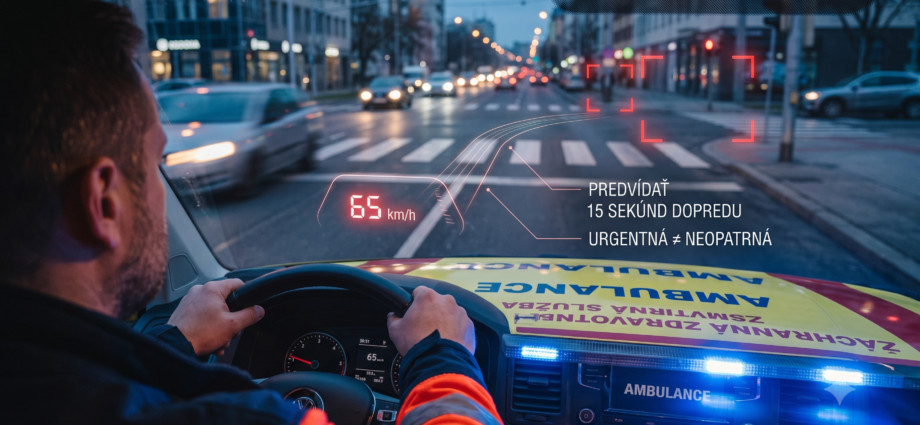
1. Aim high in steering — watch the situation at least 15 seconds of driving ahead of the vehicle, not just immediately in front of the hood.
2. Get the big picture — peripheral vision, mirrors, movement on sidewalks and side streets.
3. Keep your eyes moving — maintain an adequate distance from the vehicle ahead, beside, and behind you.
4. Leave yourself an out — lights, signaling, being visible in other drivers’ field of view.
5. Make sure they see you — don’t assume other drivers will do what they’re supposed to. Assume they might not.
What emergency driving is
Emergency driving is operating an EMS vehicle with active priority driving (blue light + siren) with the goal of reaching the scene of a call or a destination facility in the shortest possible time, using the entitlements of § 41 of Slovak Act No. 8/2009 Coll. — passing through a red light, exceeding the speed limit, driving in the oncoming lane.
Emergency driving doesn’t suspend the principles of defensive driving — on the contrary, it places even higher demands on them. A driver operating in emergency mode must anticipate the situation further ahead, because their speed and maneuvers are harder for other road users to predict.
A driver of a vehicle with the right of priority driving is obligated to exercise the necessary caution so as not to endanger other road users — this duty applies regardless of speed, call priority, or the patient’s condition.
Source: § 41(1) of Act No. 8/2009 Coll. on Road TrafficWhere the line is — a comparison
Both defensive and emergency driving share one absolute principle: the driver must not endanger other road users. This principle doesn’t disappear during priority driving — it becomes, on the contrary, harder to fulfill, and therefore requires greater concentration and better anticipation.
Five situations where drivers make mistakes
1. Excessive speed in built-up areas
Emergency driving in a city at 90 km/h or more is a tactical mistake — not just a legal one. Other drivers’ and pedestrians’ reaction distance to a siren is limited by buildings, parked cars, and building corners. At such speed, the EMS driver loses the ability to react to unpredictable situations that emerge from the sides.
Most experienced EMS drivers cite 60–70 km/h as the upper limit of safe emergency driving in built-up areas — not for legal reasons, but tactical ones. At this speed, a driver is able to stop before an unforeseen obstacle even in a situation where other drivers aren’t reacting. Above this limit, that ability drops significantly.
2. Passing through a red light without verifying the situation
The most common cause of EMS vehicle accidents in Slovakia and worldwide. Before entering an intersection against a red light, the driver must slow to a speed at which they can stop, visually confirm that all directions are clear or that other drivers are stopping — and only then continue. If uncertain — stop and wait for a gap in traffic.
Research shows that a driver in an air-conditioned vehicle with music playing may not hear an ambulance siren until it’s less than 10 meters away — which, at a speed of 50 km/h, is an insufficient reaction distance to stop. An EMS driver must account for this every time they pass through a red light.
3. Driving in the oncoming lane without certainty about the situation
Driving in the oncoming lane is justified only when the driver can see the situation ahead for a sufficient distance and is certain that oncoming vehicles are reacting. Entering the oncoming lane around a corner, over a hill crest, or in a section with poor visibility is a tactical mistake with potentially fatal consequences.
4. Ignoring road-surface conditions at higher speed
A wet road, snow, ice, or gravel significantly lengthen braking distance. A driver who operates in emergency mode at the same speed in dry and rainy conditions isn’t respecting the basic principle of adjusting speed to road conditions — even during priority driving.
5. Distraction during emergency driving
Communication with the crew, the radio, navigation — all of these are sources of distraction. During active emergency driving in a demanding situation, the paramedic should take over communication with the operations center and navigation while the driver fully concentrates on driving. This isn’t a courtesy — it’s a safety standard.
When to switch from emergency to defensive
Emergency driving isn’t a binary state — during a single call, the driver may switch several times between a higher and lower level of risk based on the current traffic situation. There are situations where the correct decision is to reduce speed or stop entirely despite active priority driving.
| Situation | Recommended driver response |
|---|---|
| A school zone, children near the road | Significant slowdown — children can enter the roadway unpredictably |
| A pedestrian at a crosswalk with a green signal | Stop — absolute pedestrian right of way, § 41 doesn’t change this |
| A blind intersection, zero visibility into side streets | Slow to a speed that allows stopping before an obstacle |
| A narrow street, doors of parked cars may open | Drive max. 30–40 km/h, watch for movement in parked vehicles |
| A train at a level crossing | Stop — the train’s right of way applies absolutely, even for EMS |
| Another EMS or fire brigade vehicle at an intersection | Stop or coordinate — two priority vehicles have no right-of-way rule between themselves |
Three scenarios from practice
A nighttime call for OHCA. The streets are empty, the driver increases speed to 100 km/h in a built-up area. They feel the situation allows it.
The driver slows before the red light to 30 km/h and enters the intersection without fully stopping, because they can’t see an approaching car from the left side.
An RZP and a fire brigade vehicle meet at an intersection — both have active priority driving, both are coming from different directions.
- VZ-TAK-01 — Defensive Driving vs. Emergency Driving — Where Is the Line? (this article)
- VZ-TAK-02 — Parking at the Scene of a Call — Tactical Vehicle Positioning
- VZ-TAK-03 — Night Driving with the Crew — Specifics and Risks
- VZ-TAK-04 — Driving in Adverse Weather Conditions
- VZ-TAK-05 — Passing Through Tunnels, Bridges, and Narrow Streets
- Slovak Act No. 8/2009 Coll. on Road Traffic, § 41(1) — duty of the driver with the right of priority driving to exercise the necessary caution and not endanger other road users.
- National Safety Council (NSC). Smith System of Defensive Driving. nsc.org, 2023.
- Pirrallo RG, Swor RA. Characteristics of fatal ambulance crashes during emergency and nonemergency operation. Prehospital Emergency Care. 1994;8(4):499–503.
- Custalow CB, Gravitz CS. Emergency medical vehicle collisions and potential for preventive intervention. Prehospital Emergency Care. 2004;8(2):175–184.
- National Highway Traffic Safety Administration (NHTSA). Emergency Vehicle Operations Course (EVOC). nhtsa.gov, 2022.
- Kahn CA, Pirrallo RG, Kuhn EM. Characteristics of fatal ambulance crashes in the United States: an 11-year retrospective analysis. Prehospital Emergency Care. 2001;5(3):261–269.