A clear guide to the technical aspects of measuring and applying immobilization devices in prehospital emergency care.
——————————————————————————–
1. Introduction to Immobilization and the MILS Principle
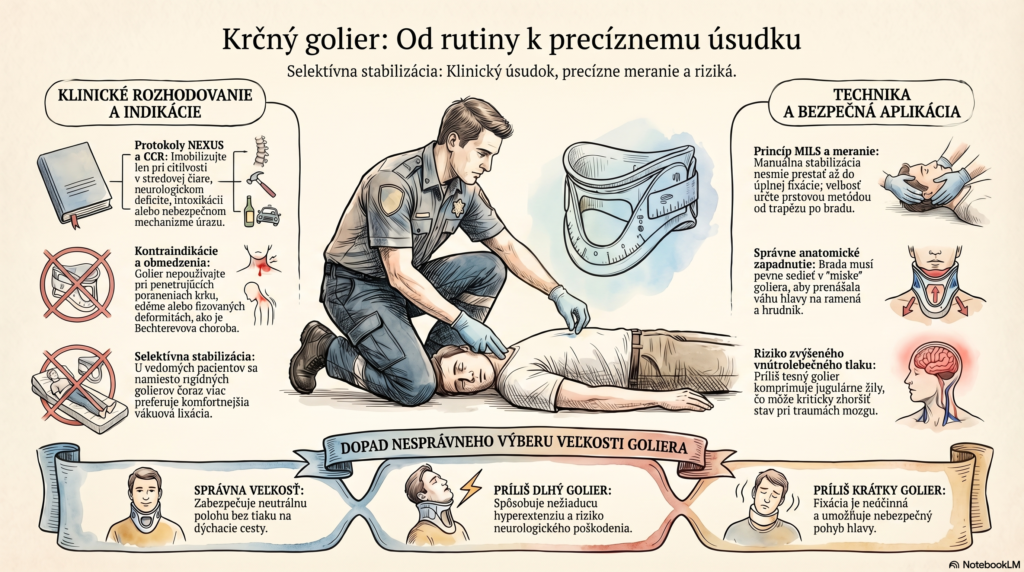
Protecting the cervical spine (C-spine) is a critical step in managing a trauma patient. Our goal is not merely mechanical restriction of movement, but above all preventing secondary spinal cord injury. As professionals, however, we must recognize that a cervical collar alone does not immobilize the spine 100% — its role is only to prevent gross movement.
The absolute priority in this process is Manual In-Line Stabilization (MILS).
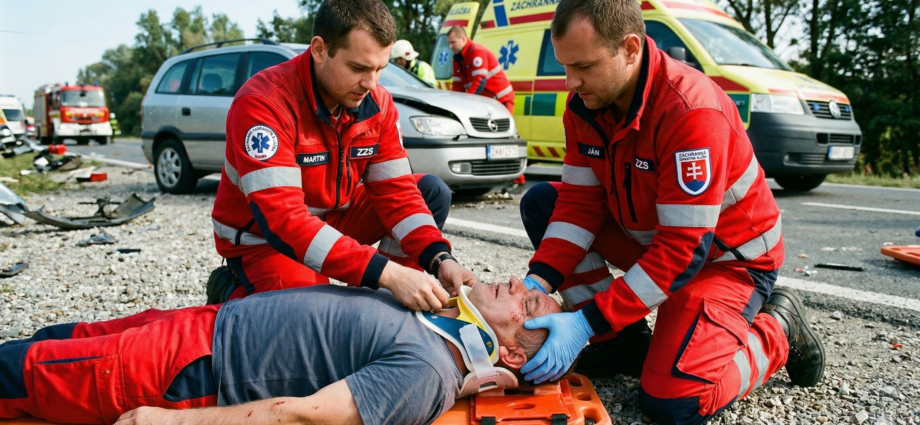
The MILS rule: Manual stabilization must be performed by the first paramedic, who holds the head in a neutral position with both hands. This stabilization is a continuous process that must not stop until the patient is fully secured on a backboard or in a vacuum mattress.
Proper stabilization creates a safe space for the next technical steps, the first of which is precise sizing of the device.
——————————————————————————–
2. Measuring Technique: The “Finger Method”
Determining the correct collar size is a manual skill performed using the paramedic’s fingers directly on the patient’s body. We identify two key anatomical landmarks: the upper edge of the trapezius muscle and the chin line.
Four-step measuring procedure:
- The paramedic extends their fingers and positions their hand at the side of the patient’s neck.
- The little finger is placed at the upper edge of the trapezius muscle, almost touching the shoulder.
- The paramedic counts how many fingers are needed to fill the distance upward to the chin line.
- The measured number of fingers is the value the paramedic then transfers to the collar’s adjustable mechanism.
“Sizing a cervical collar is not an exact science. Since only a limited number of sizes are available, the paramedic must aim for the best possible clinical estimate based on this finger measurement.”
The measured value serves as the basis for mechanically adjusting the collar itself.
——————————————————————————–
3. Preparing and Adjusting the Device (Stifneck Select)
In the EMS setting we primarily use adjustable extrication collars (e.g., Stifneck Select). The measured finger count is transferred to the collar’s scale and the mechanism is locked in place. Modern collars also feature a tracheal opening, which allows carotid pulse checks, access to an existing tracheostomy, or performance of an emergency cricothyrotomy without removing the collar.
| Condition | Description and Impact on the Patient |
| Correct size | Maintains a neutral head position and effective fixation without pressure on the airway. |
| Collar too long | Causes unwanted hyperextension of the neck, which can worsen neurological injury. |
| Collar too short | Fixation is ineffective, the head has room to move, risking secondary trauma. |
Once the correct size is set and functional elements are checked, application follows depending on the patient’s position.
——————————————————————————–
4. Application Technique: Supine vs. Seated Patient
The technical approach differs depending on patient position, but the principle of protecting the spine remains constant.
Seated patient
For a patient in a seated position (e.g., in a vehicle), we approach application as follows:
- The collar is applied to the neck from the front.
- The paramedic performing MILS may hold the head from behind or from the side.
- We smoothly slide the front piece under the chin without exerting pressure on the cervical spine.
Supine patient
For a patient on the ground or on a stretcher, the procedure is adapted due to contact with the surface:
- The back piece of the collar is first carefully slid under the neck at the point of the natural cervical curve.
- The front piece is then shaped and positioned toward the chin.
- Any movement of the head upward off the surface is minimized.
Regardless of position, the final placement of the chin must be anatomically precise.
——————————————————————————–
5. Anatomical Fit and Fixation
The key moment of successful application is precise seating of the chin into the collar’s fixation “cup.” This element carries the weight of the head and transfers it to the sternum and shoulders.
FIXATION CHECKLIST:
- The chin must sit precisely and firmly in the molded “cup” (front piece of the collar).
- The back piece of the collar must be centered exactly at the middle of the neck.
- The Velcro closure must be secure but must not restrict breathing, jaw movement, or venous drainage from the head.
A correctly applied collar is only the beginning — the paramedic must also know the situations where its use is dangerous.
——————————————————————————–
6. Contraindications and Clinical Risks
Applying a cervical collar carries specific risks that must be assessed in the field.
| Contraindication / Risk | Reason / Mechanism of Injury |
| Penetrating neck trauma | Risk of masking a developing hematoma and complicating airway management. |
| Neck edema (swelling) | An anatomical obstacle preventing correct, safe application. |
| Fixed deformities (Ankylosing spondylitis) | Risk of extremely dangerous extension; fixate only in the position of comfort. |
| Extreme obesity | The collar does not fit anatomically; fixation is managed with padding/bolsters. |
| Elevated intracranial pressure (ICP) | Compression of the jugular vein impairs venous drainage from the head, worsening outcomes in brain trauma. |
| Pressure injuries | Lesions can develop at the occiput and chin on a hard surface within just 30 minutes. |
Beyond anatomical obstacles, there are also specific patient populations requiring an adapted approach.
——————————————————————————–
7. Special Populations: Children, Pregnant Patients, and the Unconscious
- Children (up to approximately 8–12 years): Have a disproportionately large head (occiput), which causes passive flexion on a flat board. This flexion can cause the posterior pharynx to buckle forward and obstruct the airway. Padding of the entire torso (approximately 2.5 cm) from shoulders to hips is required to achieve a neutral position.
- Pregnant patients: In the 2nd and 3rd trimesters, there is a risk of inferior vena cava syndrome. The entire backboard must be tilted onto the left side (15–30 degrees) by padding the right side by 10–15 cm.
- Unconscious patients: With an unprotected airway, there is a high risk of aspiration. We prefer the HAINES position or a modified lateral trauma position, which keep the spine in a near-neutral alignment.
Modern emergency services are moving away from automatic application toward selective decision-making.
——————————————————————————–
8. Selective Immobilization: When Not to Apply a Collar
The concept of “selective spinal motion restriction” uses the NEXUS and CCR protocols to rule out unnecessary immobilization. A vacuum mattress is often preferred, as it better conforms to anatomy and causes less stress than rigid devices.
Immobilization IS REQUIRED if at least one NEXUS criterion is met:
- [ ] Midline spinal tenderness
- [ ] Neurological deficit (weakness, tingling)
- [ ] Altered level of consciousness (GCS below 15)
- [ ] Intoxication (alcohol, drugs)
- [ ] Painful distracting injury (another severe pain masking neck symptoms)
Under the Canadian C-Spine Rule (CCR), indications also include a dangerous mechanism of injury (fall from height > 1 m, high-speed motor vehicle collision), age over 65, or inability to rotate the head 45 degrees.
Final summary: The cervical collar is a tool that requires clinical judgment, not mechanical habit. For true immobilization, it must always be combined with lateral head blocks and a vacuum mattress or backboard. The collar alone only prevents gross movement, and incorrect application can seriously harm the patient.
DISCUSSION
There is currently an ongoing professional debate about the shift from “universal immobilization” to “selective spinal motion restriction.” Numerous international studies suggest that in alert patients without neurological deficit, a rigid collar may be counterproductive due to discomfort and stress. The Slovak paramedic community is gradually adopting trends where vacuum fixation, which better conforms to the patient’s anatomy, is used more often instead of rigid collars.
CONCLUSION
The cervical collar remains an important tool in trauma management, but its use must result from clinical assessment, not automatic habit. For the paramedic, precise measuring technique, awareness of the risks of elevated ICP, and consistent manual head stabilization throughout the entire application process are essential.
REFERENCES
- PHTLS: Prehospital Trauma Life Support. 10th edition. Jones & Bartlett Learning, 2023.
- Slovak Ministry of Health Standard Procedures: Management of a patient with suspected spinal injury in prehospital care.
- European Resuscitation Council (ERC) Guidelines 2021: First Aid section.
- NEXUS Criteria and Canadian C-Spine Rule: Clinical decision tools in trauma.
- Dobiáš, V.: Emergency Medicine. Prehospital Emergency Medicine. Osveta, 2021.