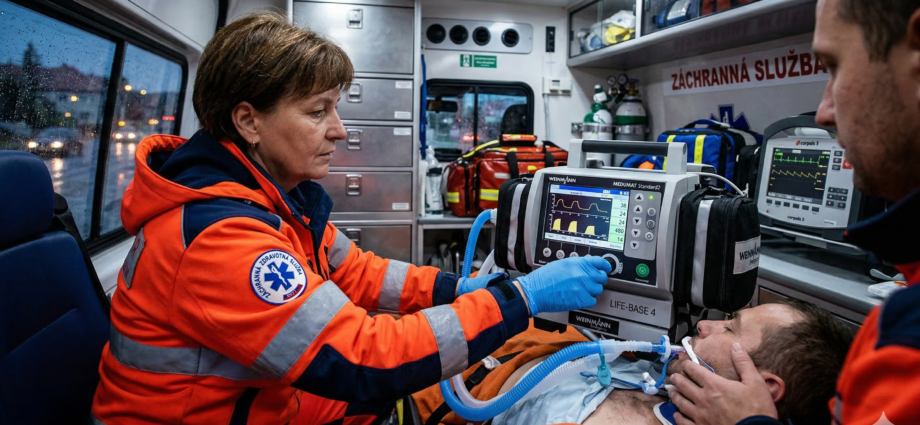
“A ventilator in a paramedic’s hands is not just a machine for pushing air. It is a bridge between clinical death and survival, one that demands perfect synergy between technical settings and the patient’s pathophysiology.”
Introduction: From the “Bag-Valve-Mask” to Digital Precision
In the era of modern emergency medicine, the line between in-hospital intensive care and the prehospital phase keeps blurring. The MEDUMAT Standard2 from Weinmann is not merely another step in the evolution of transport ventilators; it is a direct answer to the need for a high clinical standard under the extreme conditions of the field. For an experienced paramedic, what matters is not just the ruggedness of the chassis, but above all the device’s ability to adapt to a rapidly changing patient condition — from rapid sequence induction (RSI) to the complex management of pulmonary edema.
This breakdown focuses on the core of the matter: how to turn technical specifications into clinical benefit.
1. Identification and Ergonomics: A Device for the Front Line
The MEDUMAT Standard2 is a certified Class IIb medical device, fully compliant with EN 13718-1 for air transport. At approximately 2.5 kg (body only), it offers an ideal balance between performance and portability.
- Durability and controls: With IP54 protection, it handles both dust and splashing water. Controls are built around mechanical buttons and a rotary dial. In practice, unlike touchscreens, the Medumat can be reliably operated even in thick response gloves, in the rain, or when the display is contaminated with blood.
- Readability: A high-contrast color TFT display eliminates glare in direct sunlight, which is critical when working on a highway or loading a patient into a helicopter.
- Power management: The Li-Ion battery guarantees up to 10 hours of operation. An integrated charging system in the ambulance (12V/24V) ensures the device is always ready for deployment once removed from its mount.
2. Strategic Setup: The First 60 Seconds Decide Everything
The key to successful ventilation is eliminating “guesswork.” The device allows immediate selection of a patient profile (Adult/Child/Neonate), which automatically defines the safety pressure limits (Pmax) and tidal volumes.
Mode selection and lung-protective strategy
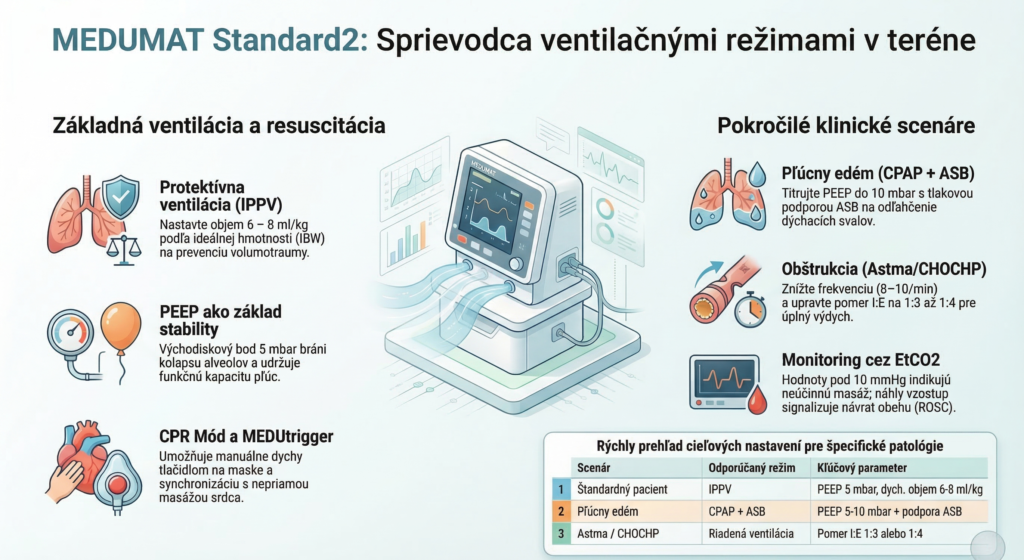
In controlled ventilation (IPPV), parameters are set strictly according to ideal body weight (IBW), not visual estimation. The standard range of 6–8 ml/kg protects the lungs from volutrauma.
PEEP: The Foundation of Alveolar Stability
A setting of 5 mbar should be the starting point for every intubated patient. This positive end-expiratory pressure prevents alveolar collapse and maintains functional residual capacity, which is essential for oxygenation during transport.
3. Clinical Scenarios and Advanced Titration
Acute cardiogenic pulmonary edema (CPAP + ASB mode)
Non-invasive ventilation (NIV) is a powerful tool in a paramedic’s hands. We start with PEEP at 5 mbar and titrate upward as needed (often up to 10 mbar). If the patient shows signs of respiratory muscle fatigue, we add pressure support ASB (+5 to +8 mbar), significantly easing the work of breathing before arrival at the cardiac center.
Obstructive disease (asthma/COPD)
When dynamic hyperinflation (auto-PEEP) is a risk, we use the device’s flexibility to lower the respiratory rate (8–10/min) and adjust the I:E ratio to 1:3 or 1:4. Watching the expiratory flow curve on the display confirms whether the patient managed to fully exhale before the next breath.
4. Monitoring and Resuscitation: CPR and RSI Modes
The Medumat Standard2 sets a new standard in resuscitation thanks to a dedicated CPR mode.
- MEDUtrigger: Allows manual breaths to be delivered via a button directly on the mask, streamlining teamwork during 30:2 ventilation.
- Capnometry: Integrated EtCO2 is our compass. Values below 10 mmHg during compressions signal ineffective compression quality, while a sudden rise in EtCO2 is the first technical indicator of ROSC (return of spontaneous circulation).
- RSI (Rapid Sequence Induction): The device supports a smooth transition from preoxygenation to full ventilation, minimizing apnea time during field intubation.
5. Operation Under Extreme Conditions and Troubleshooting
Field work brings complications the device responds to with intelligent alerts:
- High pressure alarm: Most often caused by bronchospasm, a kinked tube, or the patient “fighting” the ventilator. Requires checking airway patency and possibly deepening sedation.
- Sudden drop in EtCO2: A critical warning sign of possible pulmonary embolism or tube dislodgement.
- Low O2 supply pressure: The device immediately warns when cylinder pressure drops below 2.7 bar, giving the paramedic time to switch the oxygen source.
6. Maintenance and Consumables
For smooth operation under Slovak EMS conditions, compatibility is key:
- Circuits: Single-use patient systems (e.g., BlueCirc) are used, eliminating the risk of cross-contamination.
- Filters: Standard HME filters (22mm/15mm) are fully compatible.
- Cleaning: Surface disinfection with alcohol-free agents protects the integrity of the plastics and the display optics. Sensor calibration runs automatically during the “pre-use” test at shift handover.
Conclusion: Technology as the Paramedic’s Partner
The MEDUMAT Standard2 is not just a piece of equipment in the ambulance; it is a clinical partner that, in critical moments, takes on part of the paramedic’s cognitive load. Its strength lies in the combination of rugged construction and sophisticated ventilation algorithms. However, no automation replaces professional judgment — our ability to interpret the data the Medumat provides is, ultimately, what saves lives.
Device readiness and regular staff training in its operation are the pillars of safe emergency ventilation.
Recommended Reading and Sources:
- ERC Guidelines 2021: Resuscitation and advanced life support.
- Weinmann Emergency: User Manual MEDUMAT Standard2 (Technical documentation).
- Hovorka, J.: Ventilation in Emergency Medicine. Osveta, 2019.
- Weingart, S.: EMCrit Podcast – Preoxygenation and Peri-intubation Ventilation.
- Slovak EMS Standard Operating Procedures: Airway management section.