1. Introduction and Strategic Importance of Precision Pharmacotherapy
In modern prehospital emergency medical services (EMS), the shift from manual infusion therapy to device-based technique represents an essential safety standard. For medications with a narrow therapeutic window, where even a slight dosing deviation can lead to fatal consequences, manually controlling an infusion in the dynamic field environment is an unacceptable risk. Patient movement, changes in hydrostatic pressure during transport, and limited visual monitoring by staff are all factors that a syringe pump (e.g., the Perfusor® compactplus) fully eliminates. The strategic goal of this methodology is to achieve maximum treatment precision, eliminate cognitive load on the paramedic, and ensure the survival of a critically ill patient through technological stability.
2. Clinical Indications and Therapeutic Protocols in the Field
Continuous, precise drug delivery is a critical factor in emergencies that directly affects hemodynamic stability and neurological outcome. Syringe pumps enable complex therapeutic protocols to be carried out with a high degree of reliability in the following indications:
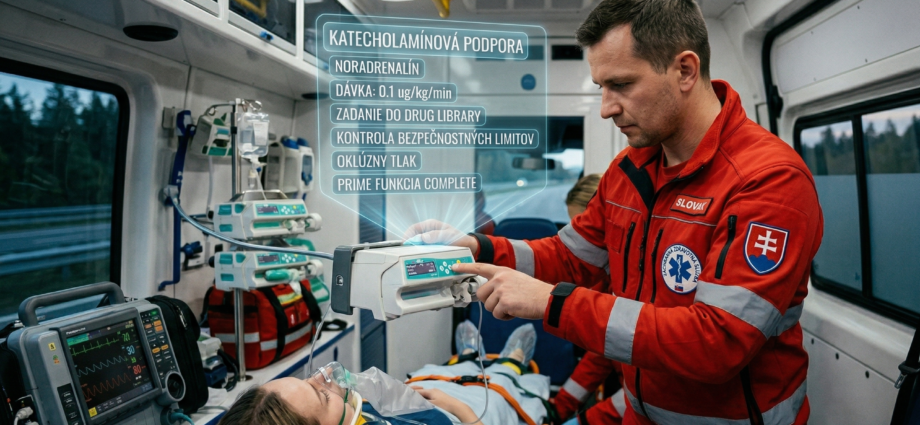
- Catecholamine support (Epinephrine, Norepinephrine, Dobutamine): Essential in shock states and post-resuscitation care. The device maintains circulatory stability without the dangerous fluctuations typical of manual titration.
- Analgesia and sedation: Long-term care of intubated patients (e.g., Sufentanil, Propofol, Midazolam). Allows a constant depth of analgosedation to be maintained, preventing sudden awakening or overdose.
- Cardiac conditions (Nitrates and Amiodarone): In acute coronary syndrome (ACS) and acute pulmonary edema, precise titration of nitrates is critical. It allows immediate, accurate response to rapid blood pressure fluctuations, which is not feasible with manual infusion during transport.
- Neurological conditions: Continuous administration of anticonvulsants in status epilepticus for exact control of seizure activity.
Shifting to a device-based solution in these cases transforms a risky manual task into a controlled clinical process.
3. Comparative Analysis: Device-Based vs. Manual Infusion
The technical stability of device-based administration is a fundamental pillar of safe treatment under the extreme conditions of EMS work. The differences between manual and device-based approaches have a direct impact on clinical outcome.
Key benefits of syringe pumps:
- Elimination of plasma level fluctuation: The device delivers medication in constant micro-doses, preventing swings in blood drug concentration.
- Weight-based dosing: Allows dosing to be set in mcg/kg/min (micrograms/kg/min), which precisely matches the patient’s physiology and reduces the risk of calculation error.
- Automatic safety monitoring: Integrated occlusion detection and air-in-line detection actively protect the patient from air embolism or paravenous administration.
These advantages, however, depend on strict adherence to the device’s technical setup protocol.
4. Operating Protocol: Device Preparation and Syringe Loading
Correct mechanical preparation is critical to preventing a delayed onset of therapeutic effect.
Syringe loading algorithm:
- Mechanical fixation: Press the release lever and slide the drive head to the right. Pull out the syringe holder (clamp), rotate it to the left, and insert the syringe so its flanges seat precisely into the fixation groove under the pump housing.
- Detection and confirmation: The device automatically recognizes the syringe size and brand (compatible with 20, 30, 50/60 ml). The operator must always confirm correct detection on the display.
- Plunger engagement: As the drive head advances toward the plunger, it automatically and securely engages it.
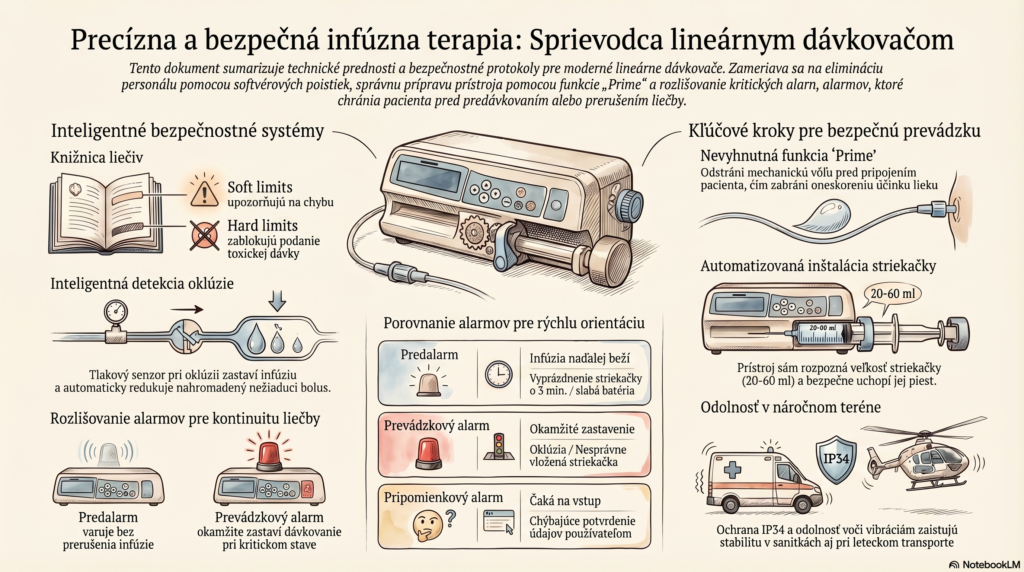
- Critical “Prime” step (purging): The Prime function purges air from the line and eliminates mechanical play in the system. This step removes any slack in the mechanism, preventing an unwanted “bolus effect” and ensuring an immediate onset of action (particularly with catecholamines).
SAFETY IMPERATIVE: The syringe and infusion line must not be connected to the patient while the syringe is being loaded or during the Prime function. The system is connected to the patient only after purging is successfully completed.
5. Dosing Configuration and the Drug Library Safety System
Software protection serves as the last barrier against medication errors in a high-stress environment.
Drug Library: The system contains predefined profiles with safety limits:
- Soft limits (warnings): Alert for a non-standard dose that can be confirmed after verification.
- Hard limits (uncrossable): The device strictly blocks entry of a dose that would be toxic or lethal to the patient.
Bolus administration procedure (model-dependent): When a sudden dose increase is needed, controls must be distinguished by hardware type:
- Perfusor® compactplus: Press the BOL button, use the arrow keys to enter the volume, and confirm with OK. (For a manual bolus, hold the BOL button.)
- Perfusor® compact: To activate a bolus, the F button must be held down simultaneously with the BOL button.
6. Alarm Management and Occlusion Monitoring
An effective response to alarms minimizes interruption of critical treatment.
| Alarm type | Meaning | Effect on infusion | Examples |
|---|---|---|---|
| Pre-alarm | Early warning | Infusion continues | 3 min. until syringe empty, 30 min. until battery depleted |
| Operational alarm | Critical condition | Infusion stops | Occlusion, battery fully depleted, incorrectly loaded syringe |
| Reminder alarm | Missing input | Waiting for command | Incomplete parameter entry (power remains on) |
Occlusion mechanism: When pressure reaches a set threshold (up to 1.2 bar), the device activates automatic bolus reduction. Once the obstruction is cleared, the device releases the pressure built up in the mechanism, protecting the patient from a sudden, unwanted injection of an excessive dose.
7. EMS-Specific Operating Conditions and System Maintenance
These devices are built for the extreme conditions of transport (IP34 protection rating, vibration resistance, Li-Ion battery with a 10-hour runtime).
Hygiene protocol and technical safety:
- Preparation: Turn off the device and disconnect it from both the patient and mains power.
- Technical safety rule (no spraying): Never spray disinfectant directly into openings, connectors, or the power connection, to avoid a short circuit.
- Application: Use a soft cloth and an approved agent (e.g., Meliseptol).
- Drying: Before returning the device to service, let it air-dry for at least 1 minute.
8. Summary of Safety Measures and Error Prevention
A syringe pump is a sophisticated tool for enhancing patient safety, not merely a passive pump.
“Top 5” errors checklist and prevention:
- Skipping the Prime function: Leads to a dangerous delay in drug onset and initial dosing inaccuracy.
- Incorrect syringe type/brand: Use only validated brands (B-D Plastipak, Monoject, Original Perfusor Syringe, Omnifix, Terumo). Using unapproved syringes causes significant dosing deviation.
- Poor mechanical fixation: Always verify the device is locked into the ambulance mounting bracket before transport.
- Ignoring operational alarms: An operational alarm requires immediate correction of the cause, not just silencing.
- Manipulation while connected to the patient: Syringe loading and purging must always be performed away from the patient, to prevent an accidental bolus.
Consistent adherence to this protocol professionalizes prehospital care, reduces the risk of medication errors, and guarantees patient safety in critical condition.
DISCUSSION: OPERATIONAL EXCELLENCE IN THE FIELD
In the EMS setting, the device is exposed to extreme conditions. The Perfusor® compactplus has an IP34 rating (protection against splashing water), which is critical during operations in adverse weather. High vibration resistance ensures stable operation both in a moving ambulance and during air transport.
Common errors and prevention:
- Error: Skipping the Prime function, leading to delayed onset of catecholamine effect.
- Prevention: Strict adherence to the startup protocol shown on the color display.
- Error: Insufficient securing of the device in its mounting bracket.
- Prevention: Visual and mechanical check of the lock before starting transport.
CONCLUSION
The Perfusor® compactplus from B. Braun represents the technological peak of infusion technique in the prehospital field. Its integration into EMS equipment leads to standardized procedures, reduces the risk of medication errors, and ensures continuity of care during patient handover at the hospital.
REFERENCES
- B. Braun Melsungen AG. Instructions for use: Perfusor® compactplus. 2023.
- European Resuscitation Council (ERC). Guidelines for Resuscitation: Post-resuscitation care. 2021.
- Slovak Chamber of Paramedics. Recommended procedures for pharmacotherapy in emergency medicine. 2024.
- PHTLS. Prehospital Trauma Life Support – 10th Edition. Jones & Bartlett Learning, 2023.
- Dobiáš, V.: Clinical Pathophysiology for Emergency Medicine. Osveta, 2021.