1. Introduction to the Topic and the Axioms of Spinal Immobilization
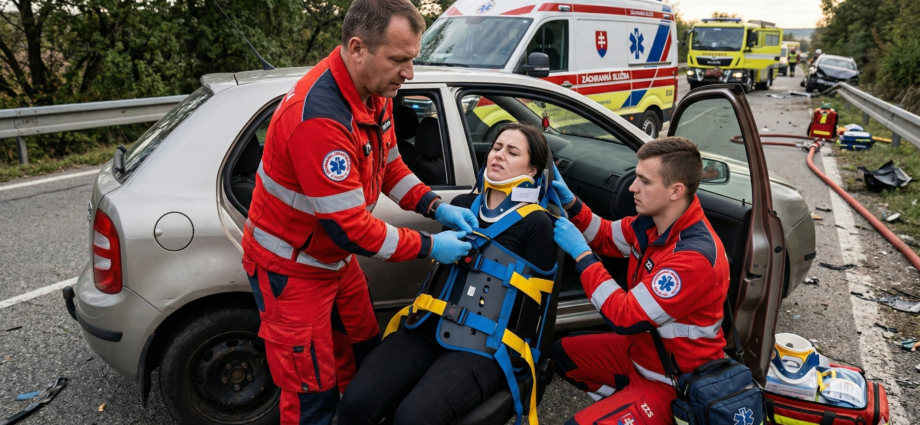
The strategic importance of gentle extrication in prehospital emergency care lies in the uncompromising prevention of secondary iatrogenic spinal cord injury. The Kendrick Extrication Device (KED), in use since the 1970s, is a semi-rigid splint designed for precise fixation of the spine along the axial plane. In the Slovak EMS setting, this system is especially critical when extracting patients from confined spaces, where a seated position limits the immediate use of a full-body spinal board.
Key objectives of axial-plane immobilization:
- Cervical region: Rigid stabilization in conjunction with an adjustable extrication collar.
- Thoracic region: Three-point trunk fixation eliminating lateral and rotational movement.
- Lumbar region: Ensuring continuity of support and stabilizing the lower torso segment.
Applying the KED must never be a purely mechanical action; it demands a high degree of clinical judgment from the medic, who must weigh, in real time, the benefit of immobilization against time pressure and the patient’s vital priorities.
2. Clinical Decision Algorithm: Gentle vs. Rapid Extrication
Time management is a critical parameter when deciding on an extrication method. Correct technical application of the KED takes a trained crew 3 to 5 minutes. Any delay in a patient with threatened vital functions directly conflicts with the Slovak Ministry of Health’s standard treatment protocols and PHTLS guidelines.
| Scenario | Care priority | Recommended approach | Clinical rationale (per protocol) |
|---|---|---|---|
| Stable patient in a seated position with suspected trauma. | Spinal (S-stability) | Gentle extrication (KED) | Prevention of secondary spinal cord injury while hemodynamically stable. |
| Unstable patient (airway obstruction, massive hemorrhage). | ABC (Life) | Rapid extrication | Vital indication takes priority; risk of death from transport delay. |
| Penetrating trauma to the chest or abdomen. | Transport (T-priority) | Rapid extrication | Need for immediate surgical management; the KED may mask progressing hemorrhage. |
| Imminent hazard (fire, explosion, aggressive patient). | Safety | Rapid extrication | Exposing the crew and patient to external danger is unacceptable. |
This algorithm bridges into the actual technical execution, where team synergy is the condition for success.
3. Technical Setup and Step-by-Step Application Method
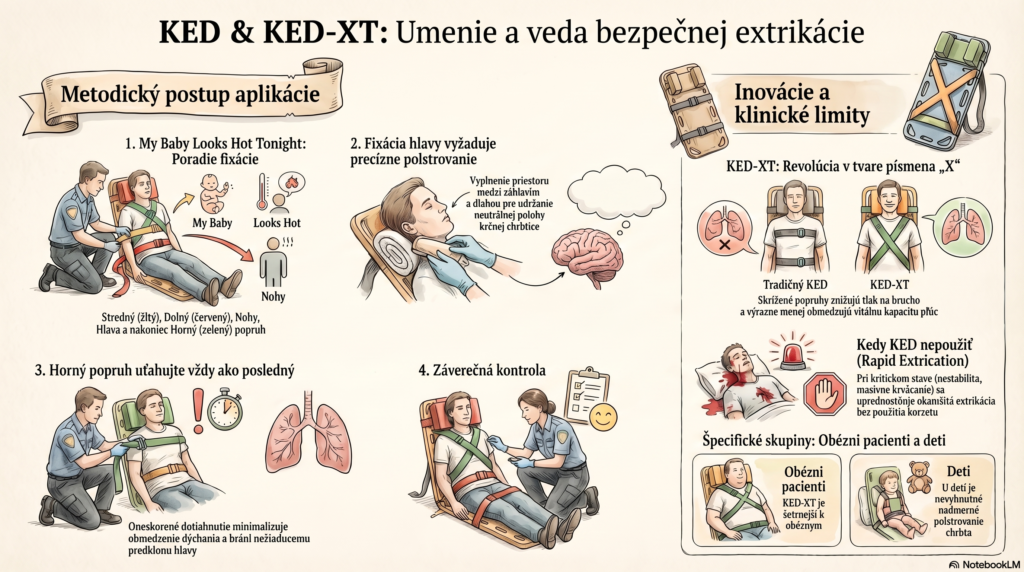
Deploying the KED system requires the cooperation of at least two paramedics. Failure to follow the fixation sequence is considered non-standard practice with a direct risk of iatrogenic trauma. The key to success is the mnemonic “My Baby Looks Hot Tonight” (MBLHT).
Application method:
- M – Middle (Middle strap – YELLOW): Fastened first. Serves as the primary anchor point, fixing the largest surface of the device to the patient’s body and creating vertical support.
- B – Bottom (Bottom strap – RED): Fixes the lower part of the chest and stabilizes the torso relative to the pelvis.
- L – Legs (Thigh straps – BLACK):
- Clinical note: Straps are threaded under the thighs using a “sawing” motion. This technique is essential to overcome resistance from clothing, avoid skin lesions, and reach the level of the ischial tuberosities without pressure on the genitals.
- H – Head: Head fixation follows only after the torso and legs are fully secured.
- Clinical note: It is mandatory to fill the space between the occiput and the device with padding to match the patient’s natural cervical lordosis. Fixation is achieved with forehead and chin/collar straps.
- T – Top (Top strap – GREEN): Tightened absolutely last, often only just before the actual transfer to the spinal board.
- Clinical rationale: This delay is critical for respiratory mechanics. The top strap crosses the upper part of the rib cage; tightening it late preserves upper chest excursion and minimizes hypoventilation during the extrication preparation phase.
4. Comparative Analysis: Classic KED vs. the Innovative KED-XT System
Technological evolution has produced the KED-XT system, which fundamentally changes how immobilization affects the patient’s cardiorespiratory reserve. While the classic system uses horizontal tension, the KED-XT works with pressure distribution.
| Parameter | Classic KED | Innovative KED-XT |
|---|---|---|
| Strap design | Mostly horizontal routing across the chest. | Crossed “X”-shaped straps (diagonal fixation). |
| Pressure on abdomen/epigastrium | High pressure increasing intra-abdominal resistance. | Significantly reduced pressure thanks to the “X” geometry. |
| Effect on lung function | Significantly greater drop in FVC and FEV1. | Milder negative effect on lung ventilation. |
| Clinical impact in obese patients | Risk of critical restriction of breathing. | Better tolerance and preservation of vital capacity. |
The KED-XT system thus effectively distributes pressure away from the epigastrium, reducing the risk of hypoxia associated with prolonged immobilization.
5. Specific Modifications for Priority Patient Groups
Within Slovak EMS methodology, an individualized approach to anatomical differences is imperative for maintaining safety.
Pediatric patient
Given the child’s disproportionately large head and the rigidity of an adult-sized KED, dangerous voids form within the device. Excessive padding must be used not only behind the head but also along the sides and back. Monitoring of the chest and abdomen must, however, remain unobstructed. Where possible, prefer a specialized pediatric splint.
Pregnant patient
When applying the lower thoracic (red) strap, the paramedic must eliminate any pressure on the uterine fundus. The upper straps must be set so as not to restrict breathing, which is physiologically more demanding in pregnancy.
Obese patient
In extreme obesity, the side flaps cannot fully wrap around the torso. Research shows that in extremely obese patients, the KED can paradoxically cause greater unwanted neck movement than gentle rapid extrication. The paramedic must weigh whether the device’s mechanical limitations outweigh its immobilization benefit.
Pelvic fracture
When a dedicated pelvic binder is unavailable, the KED can be used in a modified position (e.g., inverted) as a temporary means of stabilizing the pelvic ring, reducing internal bleeding.
6. Safety Protocol: Risks, Iatrogenic Errors, and Prevention
Responsibility for the integrity of the patient’s spinal cord rests with the scene commander. The errors listed below are classified as critical methodological failures.
Expert warning – iatrogenic error prevention protocol:
- ERROR: Head anteflexion. Caused by prematurely tightening the top (green) strap before the head is secured to the splint.
- CONSEQUENCE: Airway compromise and secondary cervical spinal injury.
- PREVENTION: Strict adherence to the M-B-L-H sequence, followed only then by T.
- ERROR: Vertical slippage of the device. Insufficiently tightened thigh straps.
- CONSEQUENCE: During extraction, the KED rides upward, losing spinal fixation.
- PREVENTION: Firm tightening at the groin using the sawing motion.
- ERROR: Respiratory failure and hypoxia. Prolonged immobilization in a classic KED.
- CONSEQUENCE: Decline in FVC/FEV1, risk in patients with chest trauma.
- PREVENTION: Minimize time in the KED; loosen the top strap during safe phases.
- ERROR: Insufficient staffing (single-medic application).
- CONSEQUENCE: Loss of manual stabilization during handling.
- PREVENTION: The KED must be operated by at least two paramedics.
7. Implementation in EMS Practice
The KED stabilization system is a sophisticated tool whose effectiveness is directly proportional to the crew’s technical skill and their ability to apply current methodological knowledge. In line with Slovak Ministry of Health standard protocols, every extrication must result from synergy between mechanical stability and the patient’s physiological tolerance.
Golden rules of extrication:
- Manual stabilization ends only once the head is fully secured with fixation straps.
- Respiratory priority: The top green strap is tightened last to preserve chest excursion.
- Clinical priority over device use: In patient instability (ABC), the KED is contraindicated.
- Neuro-monitoring: Always check neurovascular status in all extremities before and after every manipulation.
DISCUSSION
In contemporary trauma care there is ongoing debate about overuse of immobilization devices. However, under specific conditions (for example, road collisions in Slovakia involving a high proportion of older vehicles), the KED remains indispensable for so-called “gentle extrication.”
The most common errors are over-tightening the top strap before the head is secured, causing head anteflexion, or under-tightening the thigh straps, causing vertical slippage of the device during extraction. The paramedic must continuously reassess neurovascular status distally, both before and after application.
CONCLUSION
The KED is a sophisticated tool that, when applied with correct methodology, significantly reduces the risk of iatrogenic spinal cord injury. For a professional Slovak paramedic, mastering not only the technical application but also the clinical judgment to distinguish between indicated immobilization and the need for rapid extrication is essential.
REFERENCES
- PHTLS: Prehospital Trauma Life Support. 10th Edition. Jones & Bartlett Learning, 2023.
- Standard Treatment Protocols for Adults – Emergency Medicine. Slovak Ministry of Health, 2024.
- KOSIR, M.: Trauma Care in the Prehospital Setting. Osveta, 2021.
- NHTSA: National Emergency Medical Services Education Standards. U.S. Department of Transportation.
- SOREIDE, K.: Epidemiology of poly-trauma. Injury, Int. J. Care Injured 40 (2009).