Daily Technical Vehicle Inspection —
what the driver must check before a shift
An emergency medical service vehicle is not just a means of transport. It’s a mobile intensive care unit. Its technical fitness directly affects the safety of the patient, the crew, and other road users.
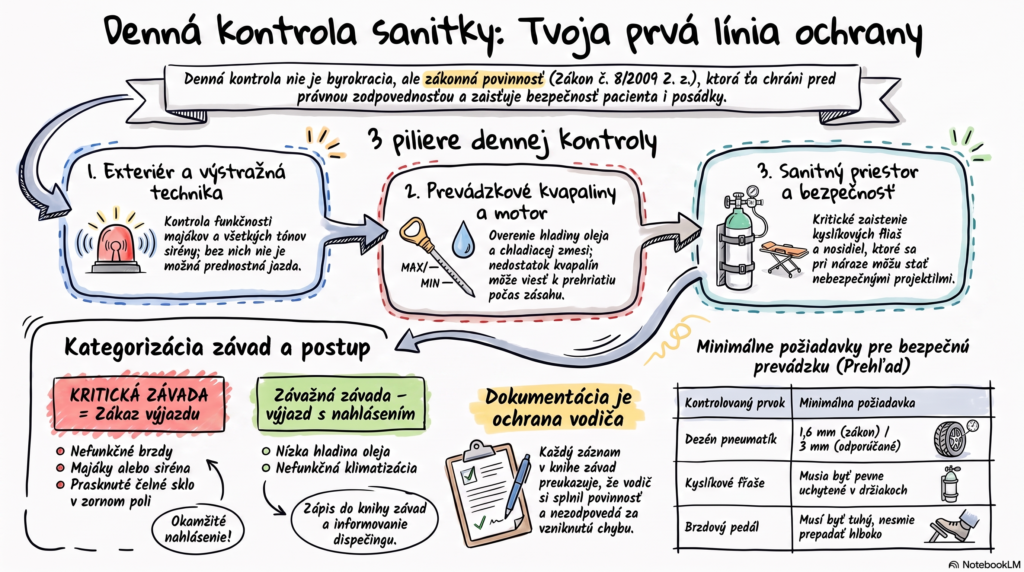
A daily technical inspection isn’t bureaucratic formality — it’s the first line of protection for the crew and the patient. A driver who starts a shift without systematically checking the vehicle takes on responsibility for risks that could have been detected back at the station.
Why the daily inspection is the driver’s duty
Act No. 8/2009 Coll. on Road Traffic, in § 4(1)(a), obligates every driver to use for driving only a vehicle that can be operated in road traffic. This duty isn’t limited to a formally valid roadworthiness certificate — it covers the vehicle’s actual technical condition at that moment. A driver who sets out with a vehicle whose defect they knew or should have known about is breaching the law — and bears responsibility for the consequences.
For EMS vehicles, this duty is further specified by Decree of the Slovak Ministry of Health No. 10548/2009-OL, which defines the minimum requirements for the material-technical equipment of ambulances. Equipment that isn’t functional isn’t equipment — the ambulance doesn’t meet operating conditions.
Responsibility for the vehicle’s technical condition lies with the vehicle operator (§ 6 of Act No. 8/2009 Coll.) — that is, the EMS provider. Responsibility for whether the vehicle can be safely used at that moment lies with the driver who takes it over for duty. These responsibilities don’t overlap — they complement each other.
Five areas of the daily inspection — what and why
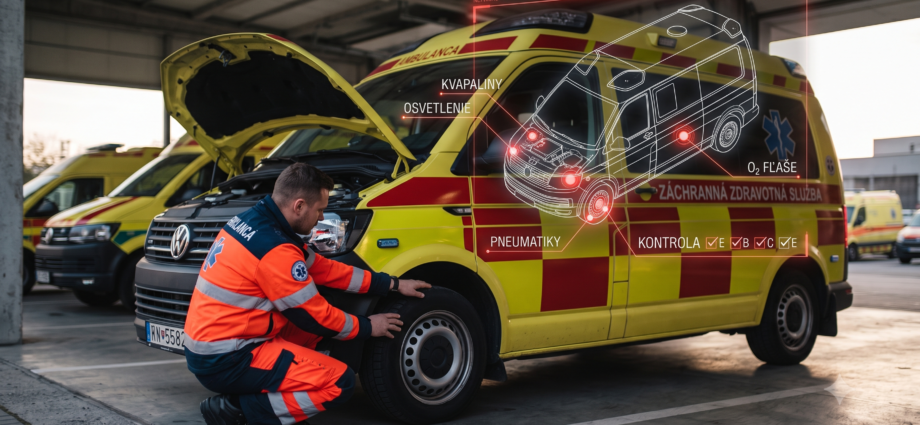
The daily inspection of an EMS/ALS vehicle can be systematically divided into five areas. Each carries a different type of risk — from immediate danger to driving safety through to the functionality of medical equipment during a call.
1. Vehicle exterior
An exterior walk-around catches damage from the previous shift, lighting problems, and tire condition. Most of these defects are visible in daylight within two minutes — and some of them directly prohibit the call from being taken.
2. Engine compartment and operating fluids
EMS vehicles are driven intensively, often in demanding conditions. Fluid levels should be checked at least at the start of every long shift, ideally at every handover. The engine compartment can reveal leaks before they manifest while driving.
3. Interior — driver’s cab
Checking the driver’s cab is quick — but neglecting it can lead to a situation where the driver discovers a malfunction during the call itself. That’s a distraction exactly when attention is needed most.
4. Patient compartment — medical equipment
This is an area where the EMS driver works alongside the paramedic (or physician) — but where the driver has a minimum duty to verify that the compartment is secured, equipment is fastened, and access is clear. A detailed check of medical equipment is primarily the paramedic’s responsibility.
5. Functional test before the first call
After the static inspection comes a brief dynamic test — verifying functionality in motion. Ideally performed while moving out of the parking spot at the station, not on the way to the first call.
What to do when a defect is found
Every defect has its own severity — not every one prohibits the call from being taken, but every one requires documentation and reporting. The driver isn’t a service technician, but they’re responsible for making sure information about a defect reaches the right place.
| Defect category | Examples | Driver’s procedure |
|---|---|---|
| Critical Prohibits the call | Non-functional brake lights, a cracked windshield in the field of view, a non-functional blue light or siren, O2 pressure below limit, an engine warning light | Immediately report to the shift supervisor / dispatch. A call with this vehicle is not possible without repair. |
| Serious Call possible, report immediately | Low oil level (top up), one non-functional turn signal bulb, bodywork damage, low O2 pressure (still above limit), faulty patient compartment A/C | Document in the vehicle defect log, report to the shift supervisor. Take the call with dispatch informed. |
| Minor Record, repair at the scheduled service | Low washer fluid, a dirty windshield, worn tread (still above limit), a loose minor interior trim piece | Record in the defect log. Top up/repair if within the driver’s means. No restriction on taking the call. |
Every defect a driver records at the start of a shift protects them from liability for a condition they didn’t create. Every defect they don’t record can become their responsibility — especially if an accident or incident occurs later.
An entry in the vehicle defect log isn’t bureaucracy. It’s evidentiary material.
Handing over the vehicle between shifts
The daily inspection carries special importance when handing over the vehicle between shifts. The driver taking over the vehicle becomes responsible for its condition from the moment they sign the handover protocol. The driver handing over the vehicle is obligated to report all known defects and the state of the equipment.
Outgoing crew: reports defects found during the shift, fuel status, oxygen cylinder status, and any non-standard situations during the shift (accident, collision, malfunction).
Incoming crew: performs their own check per this checklist — even if the outgoing crew states everything is fine. Responsibility for undetected defects passes to the incoming driver at the moment of handover.
- VZ-TECH-01 — Daily Technical Vehicle Inspection for EMS/ALS Units (this article)
- VZ-TECH-02 — Vehicle Breakdown During a Call — Procedure and Protocol
- VZ-TECH-03 — Communicating with Dispatch During a Vehicle Outage
- Slovak Act No. 8/2009 Coll. on Road Traffic, § 4(1)(a) — driver’s duty to use only a technically fit vehicle.
- Slovak Act No. 8/2009 Coll., § 6 — duties of the vehicle operator.
- Decree of the Slovak Ministry of Health No. 10548/2009-OL of March 11, 2009, laying down details on emergency medical services, as amended — Annex 3, material-technical equipment of EMS ambulances (including O2, stretcher, defibrillator, and fire extinguisher requirements).
- Slovak Act No. 579/2004 Coll. on Emergency Medical Services and on Amendments to Certain Acts.
- Decree of the Slovak Ministry of Health No. 287/2005 Coll., amending Decree No. 741/2004 Coll. — EMS vehicle marking requirements.
- National EMS Management Association (NEMSMA). EMS Vehicle Safety and Inspection Practices. 2022. nemsma.org
- Bledsoe BE, Porter RS, Cherry RA. Paramedic Care: Principles and Practice. 5th ed. Pearson, 2017. Chapter: EMS Vehicle Operations.