Communicating with Dispatch
During a Vehicle Outage
During a vehicle failure, the radio is just as important as the fire extinguisher. A structured, precise, and fast report to dispatch determines how quickly a replacement crew reaches the patient.
Most EMS crews know what to do technically when a vehicle breaks down. Few know exactly what to tell dispatch — in what structure, with what information, and in what order. Yet the quality of that report determines the speed and precision of dispatch’s response.
Why the report structure matters
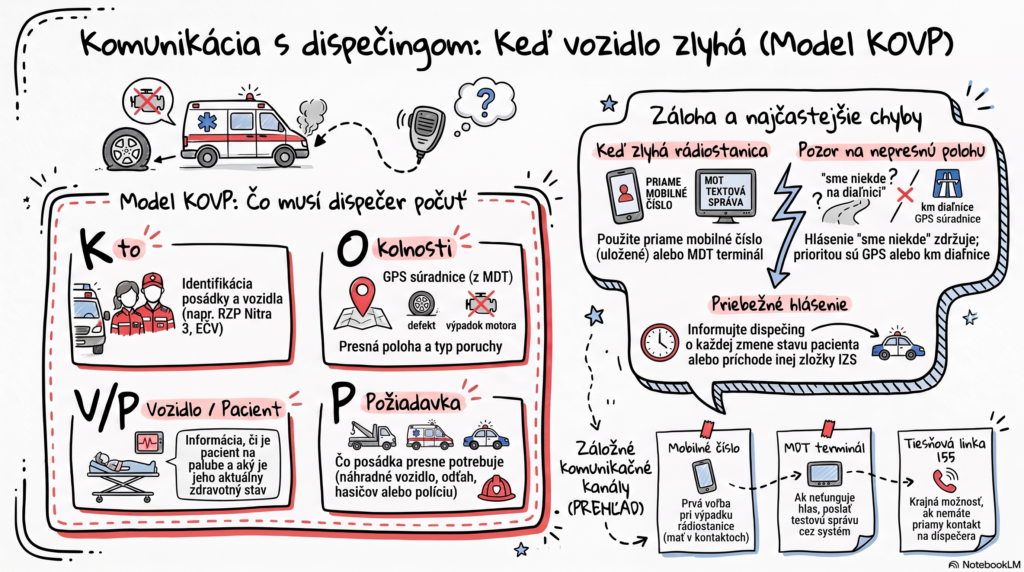
An EMS dispatcher simultaneously coordinates dozens of crews, watches the call map, and communicates with multiple units. When a failure report comes in, the dispatcher needs five pieces of information — and needs them fast, in logical order, without unnecessary context. A chaotic or incomplete report forces the dispatcher to ask follow-up questions, which extends the response time.
1. WHO — vehicle identification (RZP/RLP number, station, license plate)
2. WHERE — the most precise location possible (GPS coordinates from the MDT, street name, landmark, motorway km)
3. WHAT — the type of failure in simple words (tire blowout, engine failure, fire, a warning light)
4. PATIENT — is there a patient on board? If yes — what’s their condition?
5. REQUEST — what the crew needs (a replacement vehicle, a tow, police, firefighters)
The reporting model: WWCR
To standardize reporting during a vehicle outage, we propose the WWCR model — an acronym from the first letters of the four key report blocks. It’s analogous to other communication models used in EMS (MIST, SBAR) and easy to remember.
W — Who: Identification of the crew and vehicle. “RZP Nitra 3” / “RLP Leopoldov 1, license plate NR-123AB”
W — Where and What: Location and type of failure. “We’re stopped on the D1 at km 87, engine failure” / “On Štefánik Street near the Tesco, front tire blowout”
C — Condition: Patient yes/no, condition. “No patient” / “We have a patient, condition stable, GCS 15” / “We have a critical patient, CPR in progress”
R — Request: What the crew needs. “Requesting a replacement vehicle and a tow” / “Requesting a replacement vehicle to take over the patient, we’ll arrange the tow ourselves”
The WWCR model — an internal communication standard; analogous to MIST/SBAR protocols in Slovak EMSSample reports — crew-to-dispatch exchanges
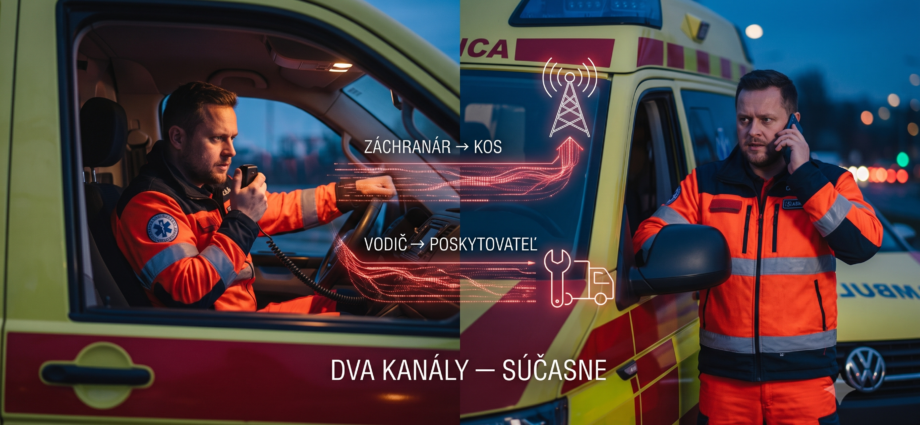
When the radio doesn’t work — backup options
A radio outage during a vehicle failure is a scenario every crew must be prepared for. Slovak Act No. 579/2004 Coll. obligates the EMS provider to ensure uninterrupted telecommunications connectivity — but a technical failure can always happen.
| Backup method | When to use | Limitations |
|---|---|---|
| Mobile phone Dispatch number saved in contacts | Primary backup for a radio outage — fast, accessible, no special training required | Depends on network coverage. The call isn’t automatically logged in the EMS operations system. |
| Emergency line 155 | If the crew doesn’t have the direct dispatch number or connection to it is interrupted — the emergency operator will transfer the call to the relevant dispatch | Longer connection time. Use only if a direct number isn’t available. |
| MDT terminal Text message via the system | If voice communication doesn’t work — the MDT allows a text report of location and status | Slower than voice reporting. Depends on the onboard system’s functionality. |
| Flagging down another EMS vehicle | The last resort — if all electronic means fail, another EMS crew can relay the report | Only if another EMS vehicle is within range. Always the last option. |
The EMS operations center’s phone number isn’t “a number that’s lying around somewhere in the vehicle.” It’s the safety net for a radio outage. Every paramedic and every EMS driver must have the dispatch number saved in their phone under a clear name — ideally as the first contact in the list. Verify the number at the start of every new shift, when changing stations, or after replacing a phone.
What dispatch needs to know as the situation evolves
A failure report isn’t a one-time communication. Dispatch must be informed of every change in the situation — improvement, deterioration, and resolution of the event.
Change in patient status — if the patient’s condition worsens or improves, dispatch must know immediately. It affects the replacement vehicle’s priority.
Change in location — if the crew moved the vehicle or the patient (e.g., for safety reasons), dispatch must know the new location to navigate the replacement vehicle.
Arrival of another emergency service — if police or firefighters arrive at the scene, inform dispatch — it can speed up coordination.
Arrival of the replacement vehicle — confirm the patient handover to the replacement crew and check out of the event.
Event closure — after handing the vehicle over to a tow or resolving a call with no patient — a brief closing report for dispatch’s records.
Three mistakes in communicating with dispatch
The crew reports: “Dispatch, this is Nitra 3, we’re on the D1, well actually we were stopped near Senec and then we continued and at km 87 our tire blew, rear right, it was pretty loud and the vehicle started pulling left, we stopped on the shoulder, we got out, put the triangle out, we’ve got reflectors here too…”
The crew reports their location as “we’re on the motorway, somewhere past Senec.” The dispatcher sends a replacement vehicle — but navigation doesn’t have a precise point.
The crew reports the failure, then communication stops. The dispatcher doesn’t know if the situation has changed, whether the patient is still stable, or whether the replacement vehicle is navigating correctly.
- VZ-TECH-01 — Daily Technical Vehicle Inspection for EMS/ALS Units
- VZ-TECH-02 — Vehicle Breakdown During a Call — Procedure and Protocol
- VZ-TECH-03 — Communicating with Dispatch During a Vehicle Outage (this article)
- Slovak Act No. 579/2004 Coll. on Emergency Medical Services, § 6(3)(a) and (b) — duties of the operations center, including ensuring uninterrupted telecommunications connectivity and satellite vehicle monitoring.
- Decree of the Slovak Ministry of Health No. 741/2004 Coll. — equipment requirements for EMS ambulances, including radio and MDT terminal.
- Slovak EMS communication protocol standard — MIST, SBAR. Internal methodological guidance of the Slovak EMS operations service.
- National EMS Management Association (NEMSMA). EMS Communications Best Practices. 2022. nemsma.org
- Bledsoe BE, Porter RS, Cherry RA. Paramedic Care: Principles and Practice. 5th ed. Pearson, 2017. Chapter: Communications.
- NAEMSP. Position Statement on EMS Communications and Dispatch. 2021. naemsp.org